Tuberculosis in India
Tuberculosis in India represents a significant public health challenge, being a country with one of the highest burdens of Tuberculosis (TB) worldwide. TB is an infectious disease caused by the bacterium Mycobacterium tuberculosis, which most commonly affects the lungs but can also impact other parts of the body. The disease is spread through the air when people who are sick with pulmonary TB expel bacteria, for example, by coughing.
Epidemiology[edit]
India accounts for about a quarter of the global TB burden. According to the World Health Organization (WHO), in 2019, India had an estimated 2.64 million cases of TB. The country also faces challenges with multidrug-resistant TB (MDR-TB) and the HIV/TB co-infection.
Government Response[edit]
The Government of India has initiated several programs and strategies to combat TB. The most notable among these is the Revised National Tuberculosis Control Program (RNTCP), which was launched in 1997. The program uses the Directly Observed Treatment, Short-course (DOTS) strategy recommended by the WHO and focuses on early detection and treatment of TB cases. In 2020, the program was rebranded as the National Tuberculosis Elimination Program (NTEP) with the goal of eliminating TB in India by 2025.
Challenges[edit]
Despite government efforts, several challenges remain in the fight against TB in India. These include the stigma associated with the disease, the prevalence of MDR-TB, and the co-epidemic of TB and HIV/AIDS. Additionally, the accuracy of TB diagnosis and the reporting of TB cases are significant challenges. The private healthcare sector in India, where a large number of TB patients first seek care, often does not follow standardized TB diagnostic and treatment protocols, leading to underreporting and mismanagement of TB cases.
Prevention and Control[edit]
Prevention and control of TB in India involve a multi-faceted approach that includes improving public awareness about TB, enhancing TB case finding and treatment adherence through community engagement, and strengthening TB surveillance and health systems. Vaccination with BCG vaccine, which provides some protection against TB, is also part of the prevention strategy.
Future Directions[edit]
The goal of eliminating TB in India by 2025 is ambitious. Achieving this target will require concerted efforts from the government, non-governmental organizations, healthcare providers, and communities. It will also necessitate significant advancements in TB diagnostics, vaccines, and treatment, alongside addressing the social determinants of health that contribute to TB transmission.
 | This medical article is a stub. You can help WikiMD by expanding the page. |
-
Depiction of a tuberculosis patient
-
Tuberculosis checkup for child, India 2009
-
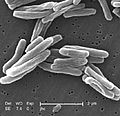 Mycobacterium tuberculosis


Medical Disclaimer: WikiMD is for informational purposes only and is not a substitute for professional medical advice. Content may be inaccurate or outdated and should not be used for diagnosis or treatment. Always consult your healthcare provider for medical decisions. Verify information with trusted sources such as CDC.gov and NIH.gov. By using this site, you agree that WikiMD is not liable for any outcomes related to its content. See full disclaimer.
Credits:Most images are courtesy of Wikimedia commons, and templates, categories Wikipedia, licensed under CC BY SA or similar.
Translate page: - East Asian
中文,
日本,
한국어,
South Asian
हिन्दी,
தமிழ்,
తెలుగు,
Urdu,
ಕನ್ನಡ,
Southeast Asian
Indonesian,
Vietnamese,
Thai,
မြန်မာဘာသာ,
বাংলা
European
español,
Deutsch,
français,
Greek,
português do Brasil,
polski,
română,
русский,
Nederlands,
norsk,
svenska,
suomi,
Italian
Middle Eastern & African
عربى,
Turkish,
Persian,
Hebrew,
Afrikaans,
isiZulu,
Kiswahili,
Other
Bulgarian,
Hungarian,
Czech,
Swedish,
മലയാളം,
मराठी,
ਪੰਜਾਬੀ,
ગુજરાતી,
Portuguese,
Ukrainian


