Transverse sinuses

The transverse sinuses are two large venous channels located within the dura mater of the human brain. They are part of the dural venous sinuses, which are responsible for draining venous blood from the brain and directing it towards the internal jugular vein.
Anatomy[edit]
The transverse sinuses are situated in the posterior part of the cranial cavity. They run laterally from the confluence of sinuses, which is located near the internal occipital protuberance, and continue along the attached margin of the tentorium cerebelli.
Course[edit]

Each transverse sinus begins at the confluence of sinuses, where it receives blood from the superior sagittal sinus, straight sinus, and occipital sinus. From there, the transverse sinuses extend laterally and anteriorly, curving around the cerebellum. They eventually transition into the sigmoid sinuses, which then drain into the internal jugular veins.
Relations[edit]
The transverse sinuses are closely related to several important structures within the cranial cavity. They are bordered superiorly by the tentorium cerebelli, a fold of dura mater that separates the cerebrum from the cerebellum. Inferiorly, they are in proximity to the cerebellum.
Function[edit]

The primary function of the transverse sinuses is to facilitate the drainage of venous blood from the brain. They collect blood from the superior sagittal sinus, straight sinus, and occipital sinus, and channel it towards the sigmoid sinuses. This venous blood is then directed into the internal jugular veins, which carry it back to the heart.
Clinical Significance[edit]

The transverse sinuses can be involved in various pathological conditions. One such condition is cerebral venous sinus thrombosis (CVST), where a blood clot forms within the sinus, leading to increased intracranial pressure and potential neurological deficits. Symptoms of CVST can include headache, visual disturbances, and seizures.
Related Pages[edit]

Additional Images[edit]
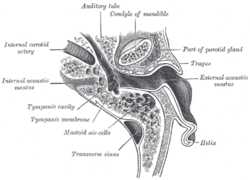
The sinuses of the brain 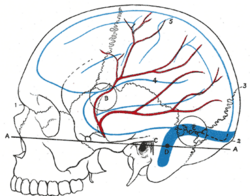
The sinuses of the dura mater 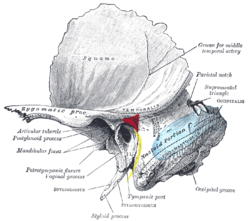
The sinuses of the dura mater, viewed from above


Medical Disclaimer: WikiMD is for informational purposes only and is not a substitute for professional medical advice. Content may be inaccurate or outdated and should not be used for diagnosis or treatment. Always consult your healthcare provider for medical decisions. Verify information with trusted sources such as CDC.gov and NIH.gov. By using this site, you agree that WikiMD is not liable for any outcomes related to its content. See full disclaimer.
Credits:Most images are courtesy of Wikimedia commons, and templates, categories Wikipedia, licensed under CC BY SA or similar.
Translate page: - East Asian
中文,
日本,
한국어,
South Asian
हिन्दी,
தமிழ்,
తెలుగు,
Urdu,
ಕನ್ನಡ,
Southeast Asian
Indonesian,
Vietnamese,
Thai,
မြန်မာဘာသာ,
বাংলা
European
español,
Deutsch,
français,
Greek,
português do Brasil,
polski,
română,
русский,
Nederlands,
norsk,
svenska,
suomi,
Italian
Middle Eastern & African
عربى,
Turkish,
Persian,
Hebrew,
Afrikaans,
isiZulu,
Kiswahili,
Other
Bulgarian,
Hungarian,
Czech,
Swedish,
മലയാളം,
मराठी,
ਪੰਜਾਬੀ,
ગુજરાતી,
Portuguese,
Ukrainian

