Dental anatomy
Dental anatomy is the field of anatomy that studies the structure and function of teeth. Teeth are essential for many functions in humans and animals, including eating, speaking, and supporting facial structures.
Structure of Teeth[edit]
Teeth are composed of four different types of tissues: enamel, dentin, cementum, and pulp.
- Enamel is the hardest and most highly mineralized substance in the human body. It covers the outer layer of each tooth and is the most visible part of the tooth.
- Dentin is the layer of the tooth that is beneath the enamel. It is less mineralized than enamel, but it is still very hard.
- Cementum is a specialized bone-like substance covering the root of a tooth. It is responsible for attaching the tooth to the jawbone.
- Pulp is the innermost part of the tooth and contains nerves and blood vessels.
Types of Teeth[edit]
Humans have four different types of teeth: incisors, canines, premolars, and molars.
- Incisors are the front teeth that are used for cutting and chopping food.
- Canines are the sharp teeth located next to the incisors and are used for tearing food.
- Premolars are located next to the canines and are used for grinding and crushing food.
- Molars are the largest teeth and are located in the back of the mouth. They are used for grinding and crushing food.
Dental Development[edit]
Human teeth develop in stages, starting in the womb and continuing into adulthood. The stages of tooth development are: the bud stage, the cap stage, the bell stage, and the crown stage.
- In the bud stage, the tooth begins to form from a tooth bud.
- In the cap stage, the tooth bud develops into a tooth cap.
- In the bell stage, the tooth cap develops into a tooth bell.
- In the crown stage, the tooth bell develops into a tooth crown.
Dental Health[edit]
Maintaining good dental health is important for overall health. Poor dental health can lead to a variety of problems, including tooth decay, gum disease, and tooth loss. Regular dental check-ups, brushing and flossing daily, and eating a healthy diet can help maintain good dental health.
See Also[edit]

This WikiMD article can only be edited by registered and verified editors. You can log in or register.
-
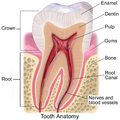 Tooth Anatomy
 -
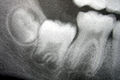 Molars in Development
 -
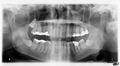 Panoramic View of Teeth
 -
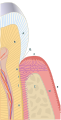 Periodontium
 -
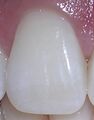 Right Central Incisor


Medical Disclaimer: WikiMD is for informational purposes only and is not a substitute for professional medical advice. Content may be inaccurate or outdated and should not be used for diagnosis or treatment. Always consult your healthcare provider for medical decisions. Verify information with trusted sources such as CDC.gov and NIH.gov. By using this site, you agree that WikiMD is not liable for any outcomes related to its content. See full disclaimer.
Credits:Most images are courtesy of Wikimedia commons, and templates, categories Wikipedia, licensed under CC BY SA or similar.
Translate page: - East Asian
中文,
日本,
한국어,
South Asian
हिन्दी,
தமிழ்,
తెలుగు,
Urdu,
ಕನ್ನಡ,
Southeast Asian
Indonesian,
Vietnamese,
Thai,
မြန်မာဘာသာ,
বাংলা
European
español,
Deutsch,
français,
Greek,
português do Brasil,
polski,
română,
русский,
Nederlands,
norsk,
svenska,
suomi,
Italian
Middle Eastern & African
عربى,
Turkish,
Persian,
Hebrew,
Afrikaans,
isiZulu,
Kiswahili,
Other
Bulgarian,
Hungarian,
Czech,
Swedish,
മലയാളം,
मराठी,
ਪੰਜਾਬੀ,
ગુજરાતી,
Portuguese,
Ukrainian

