Tokamak
Tokamak is a device used in nuclear fusion research for magnetic confinement of plasma. It is one of several types of magnetic confinement devices being developed to produce controlled thermonuclear fusion power. As of 2021, it is the leading candidate for a practical fusion reactor.
History[edit]
The tokamak was invented in the 1950s by Soviet physicists Igor Tamm and Andrei Sakharov, inspired by an original idea of Oleg Lavrentiev. The name is a Russian acronym for "toroidal chamber with magnetic coils".
Design and operation[edit]
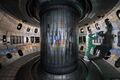
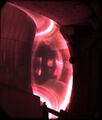
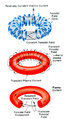
A tokamak is essentially a torus, or doughnut-shaped vessel, in which a powerful magnetic field is used to confine a plasma of ions and electrons. The magnetic field is produced by a combination of external coils and a large current flowing in the plasma itself. The plasma is heated to temperatures of tens of millions of degrees, at which point the ions can overcome their mutual repulsion and fuse together, releasing a large amount of energy.
Major tokamaks[edit]
Several major tokamaks have been built around the world, including the Joint European Torus (JET) in the UK, the Tokamak Fusion Test Reactor (TFTR) in the US, and the T-15 in Russia. The largest and most ambitious tokamak project currently underway is the International Thermonuclear Experimental Reactor (ITER) in France, which is expected to be the first tokamak to produce a net gain in energy.
Challenges and criticism[edit]
Despite its promise, the tokamak approach to fusion power has faced several challenges. These include the difficulty of maintaining a stable plasma, the high cost of building and operating large tokamaks, and the problem of neutron radiation damage to the tokamak's structure. Some critics also argue that other approaches to fusion power, such as inertial confinement fusion or magnetic mirror devices, may be more promising.
See also[edit]
- Nuclear fusion
- Magnetic confinement fusion
- Inertial confinement fusion
- Magnetic mirror
- Plasma (physics)
 | This physics-related article is a stub. You can help WikiMD by expanding the page. |
- Tokamak
-
 Tokamak
 -
 Tokamak
 -
Tokamak
-
 Tokamak
 -
Tokamak
-
Tokamak
-
Tokamak
-
Tokamak
-
Tokamak
-
 Tokamak
 -
Tokamak
-
Tokamak


Sponsored Health Resource

W8MD Weight Loss, Sleep & MedSpa
Looking for physician-supervised weight loss, semaglutide, tirzepatide, or GLP-1 receptor agonist options? W8MD helps eligible patients in New York City, Brooklyn, New Jersey, Connecticut, Pennsylvania, Delaware, and greater Philadelphia with medical weight loss, sleep medicine, and long-term maintenance support.
GLP-1 specials: Affordable GLP-1 injections NYC and Philadelphia starting from $29.99/week and up for semaglutide with insurance accepted for qualifying visits, and $45/week and up for tirzepatide with insurance accepted for qualifying visits. Self-pay options start from $59.99/week and up for semaglutide and $69.99/week and up for tirzepatide.
Medical weight loss NYC | Affordable GLP-1 injections NYC | Budget GLP-1 weight loss shots Philadelphia | New Jersey medical weight loss | NYC medical weight loss | Philadelphia medical weight loss | Sleep clinic NYC | W8MD's Philadelphia GLP-1 doctor | Weight loss prescriptions NYC
Book a W8MD appointment · View GLP-1 specials
Paid promotional message. Eligibility, pricing, insurance coverage, medication availability, and results vary. Medical evaluation required.

Medical Disclaimer: WikiMD is for informational purposes only and is not a substitute for professional medical advice. Content may be inaccurate or outdated and should not be used for diagnosis or treatment. Always consult your healthcare provider for medical decisions. Verify information with trusted sources such as CDC.gov and NIH.gov. By using this site, you agree that WikiMD is not liable for any outcomes related to its content. See full disclaimer.
Credits:Most images are courtesy of Wikimedia commons, and templates, categories Wikipedia, licensed under CC BY SA or similar.
Translate page: - East Asian
中文,
日本,
한국어,
South Asian
हिन्दी,
தமிழ்,
తెలుగు,
Urdu,
ಕನ್ನಡ,
Southeast Asian
Indonesian,
Vietnamese,
Thai,
မြန်မာဘာသာ,
বাংলা
European
español,
Deutsch,
français,
Greek,
português do Brasil,
polski,
română,
русский,
Nederlands,
norsk,
svenska,
suomi,
Italian
Middle Eastern & African
عربى,
Turkish,
Persian,
Hebrew,
Afrikaans,
isiZulu,
Kiswahili,
Other
Bulgarian,
Hungarian,
Czech,
Swedish,
മലയാളം,
मराठी,
ਪੰਜਾਬੀ,
ગુજરાતી,
Portuguese,
Ukrainian


.jpg)


