Tilletia caries
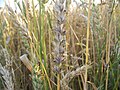
Tilletia caries (also known as common bunt or stinking smut) is a fungal pathogen that primarily affects wheat crops. It is a member of the Tilletia genus and the Tilletiaceae family. The fungus is known for its destructive potential and the unpleasant odor it imparts to infected crops.
Life Cycle[edit]
The life cycle of Tilletia caries begins when its spores infect the wheat plant. The spores germinate and penetrate the plant's tissues, eventually reaching the developing grain. Inside the grain, the fungus proliferates and replaces the normal grain tissues with its own mycelium. The infected grain, now filled with fungal spores, emits a foul odor.
Impact on Agriculture[edit]
Tilletia caries poses a significant threat to wheat production worldwide. Infected crops are often rendered unsuitable for consumption due to the unpleasant odor and taste. In addition, the fungus can persist in the soil for many years, making it difficult to eradicate once established.
Control and Management[edit]
Control of Tilletia caries involves a combination of crop rotation, use of resistant wheat varieties, and fungicide application. Early detection and removal of infected plants can also help to limit the spread of the disease.
See Also[edit]

|
|
This article is a stub You can help WikiMD by registering and expanding it with useful details, internal links, formatting, and categories. Editing is available only to registered and verified users. WikiMD is a comprehensive, free health and wellness encyclopedia. |

-
 Tilletia caries spores under microscope
 -
 Life cycle of Tilletia caries
 -
 Historical combine harvester in Walla Walla, ca. 1902
_Tul._%26_C._Tul..JPG)


Medical Disclaimer: WikiMD is for informational purposes only and is not a substitute for professional medical advice. Content may be inaccurate or outdated and should not be used for diagnosis or treatment. Always consult your healthcare provider for medical decisions. Verify information with trusted sources such as CDC.gov and NIH.gov. By using this site, you agree that WikiMD is not liable for any outcomes related to its content. See full disclaimer.
Credits:Most images are courtesy of Wikimedia commons, and templates, categories Wikipedia, licensed under CC BY SA or similar.
Translate page: - East Asian
中文,
日本,
한국어,
South Asian
हिन्दी,
தமிழ்,
తెలుగు,
Urdu,
ಕನ್ನಡ,
Southeast Asian
Indonesian,
Vietnamese,
Thai,
မြန်မာဘာသာ,
বাংলা
European
español,
Deutsch,
français,
Greek,
português do Brasil,
polski,
română,
русский,
Nederlands,
norsk,
svenska,
suomi,
Italian
Middle Eastern & African
عربى,
Turkish,
Persian,
Hebrew,
Afrikaans,
isiZulu,
Kiswahili,
Other
Bulgarian,
Hungarian,
Czech,
Swedish,
മലയാളം,
मराठी,
ਪੰਜਾਬੀ,
ગુજરાતી,
Portuguese,
Ukrainian

