Tiffeneau–Demjanov rearrangement
Tiffeneau–Demjanov rearrangement is a chemical reaction that involves the rearrangement of nitrogen-containing compounds, specifically amines, to produce a variety of structurally complex molecules. This reaction is named after the French chemist Marc Tiffeneau and the Russian chemist Nikolai Demjanov, who independently discovered and developed the process in the early 20th century. The Tiffeneau–Demjanov rearrangement is particularly significant in the field of organic chemistry for its application in the synthesis of cyclic amines and other nitrogen-containing heterocycles, which are important in the development of pharmaceuticals and other biologically active compounds.
Mechanism[edit]
The Tiffeneau–Demjanov rearrangement typically begins with the treatment of a secondary amine with a strong oxidizing agent, such as nitrous acid (HNO2), to form a nitrosoamine. This intermediate then undergoes a series of transformations, including the loss of water (dehydration) and the migration of an alkyl group, to generate a new carbon-nitrogen bond. The final product is often a cyclic amine or a related nitrogen-containing heterocycle, depending on the specific substrates and conditions used in the reaction.
Applications[edit]
The versatility of the Tiffeneau–Demjanov rearrangement has made it a valuable tool in organic synthesis. It is particularly useful for the construction of complex cyclic structures from simpler acyclic precursors. This capability has been exploited in the synthesis of a wide range of biologically active molecules, including alkaloids, which are compounds often found in plants and have medicinal properties. Additionally, the reaction has been applied in the synthesis of various pharmaceuticals, demonstrating its importance in the development of new drugs.
Variations[edit]
Several variations of the Tiffeneau–Demjanov rearrangement exist, each tailored to specific types of substrates or desired products. These variations often involve different reagents or reaction conditions to achieve the rearrangement or to control the selectivity of the reaction. For example, the use of different oxidizing agents or the application of specific catalysts can lead to the formation of different products from the same starting materials.
See Also[edit]
References[edit]
<references/>

Tiffeneau–Demjanov rearrangement[edit]
-
 Tiffeneau–Demjanov rearrangement scheme
 -
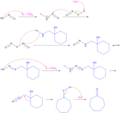 Tiffeneau–Demjanov rearrangement


Ad. Transform your life with W8MD's
GLP-1 weight loss injections special from $29.99


W8MD Medical Weight Loss, Sleep and Medspa offers physician-supervised medical weight loss programs: NYC medical weight loss Philadelphia medical weight loss
Affordable GLP-1 Weight Loss ShotsAffordable GLP-1 Weight Loss Shots
Budget GLP-1 injections NYC (insurance & self-pay options) Popular treatments:
- Semaglutide starting from $29.99/week
- Tirzepatide starting from $45.00/week
✔ Most insurances accepted for visits ✔ Prior authorization support when eligible
Start your physician weight loss NYC journey today:
📍 NYC: Brooklyn weight loss center 📍 Philadelphia: Philadelphia weight loss center
📞 Call: 718-946-5500 (NYC) | 215-676-2334 (Philadelphia)
Tags: Affordable GLP1 weight loss NYC, Wegovy NYC, Zepbound NYC, Philadelphia medical weight loss


|
WikiMD Medical Encyclopedia |
Medical Disclaimer: WikiMD is not a substitute for professional medical advice. The information on WikiMD is provided as an information resource only, may be incorrect, outdated or misleading, and is not to be used or relied on for any diagnostic or treatment purposes. Please consult your health care provider before making any healthcare decisions or for guidance about a specific medical condition. WikiMD expressly disclaims responsibility, and shall have no liability, for any damages, loss, injury, or liability whatsoever suffered as a result of your reliance on the information contained in this site. By visiting this site you agree to the foregoing terms and conditions, which may from time to time be changed or supplemented by WikiMD. If you do not agree to the foregoing terms and conditions, you should not enter or use this site. See full disclaimer.
Credits:Most images are courtesy of Wikimedia commons, and templates, categories Wikipedia, licensed under CC BY SA or similar.
Translate this page: - East Asian
中文,
日本,
한국어,
South Asian
हिन्दी,
தமிழ்,
తెలుగు,
Urdu,
ಕನ್ನಡ,
Southeast Asian
Indonesian,
Vietnamese,
Thai,
မြန်မာဘာသာ,
বাংলা
European
español,
Deutsch,
français,
Greek,
português do Brasil,
polski,
română,
русский,
Nederlands,
norsk,
svenska,
suomi,
Italian
Middle Eastern & African
عربى,
Turkish,
Persian,
Hebrew,
Afrikaans,
isiZulu,
Kiswahili,
Other
Bulgarian,
Hungarian,
Czech,
Swedish,
മലയാളം,
मराठी,
ਪੰਜਾਬੀ,
ગુજરાતી,
Portuguese,
Ukrainian
