Thymidylate synthase
Thymidylate synthase (TS) is an enzyme that plays a crucial role in the replication of the cell's DNA. It is part of the folate pathway, which is responsible for the formation of tetrahydrofolate and its derivatives. TS is the target of many chemotherapeutic agents, including 5-fluorouracil and raltitrexed.
Function[edit]
Thymidylate synthase catalyzes the conversion of deoxyuridine monophosphate (dUMP) to deoxythymidine monophosphate (dTMP). This reaction is crucial in the DNA replication process because dTMP is required for the synthesis of DNA. Without sufficient dTMP, cells can undergo "thymineless death."
Structure[edit]
The structure of thymidylate synthase is highly conserved among different species, indicating its importance in cellular function. The enzyme is a homodimer, with each monomer consisting of a single polypeptide chain. The active site, where the catalytic reaction occurs, is located at the interface of the two monomers.
Clinical significance[edit]
Because of its role in DNA replication, thymidylate synthase is a target for chemotherapeutic drugs. These drugs inhibit the function of TS, preventing the synthesis of new DNA and thus stopping the proliferation of cancer cells. Examples of such drugs include 5-fluorouracil and raltitrexed.
See also[edit]
References[edit]

This WikiMD article can only be edited by registered and verified editors. You can log in or register.
Thymidylate_synthase[edit]
-
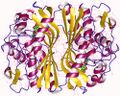 Thymidylate_synthase
 -
Simple Cycle of Thymidylate Synthase
-
Mechanism of Thymidylate Synthase
-
Thymidylate Synthase as a homodimer
-
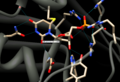 Active site of Thymidylate Synthase


Medical Disclaimer: WikiMD is for informational purposes only and is not a substitute for professional medical advice. Content may be inaccurate or outdated and should not be used for diagnosis or treatment. Always consult your healthcare provider for medical decisions. Verify information with trusted sources such as CDC.gov and NIH.gov. By using this site, you agree that WikiMD is not liable for any outcomes related to its content. See full disclaimer.
Credits:Most images are courtesy of Wikimedia commons, and templates, categories Wikipedia, licensed under CC BY SA or similar.
Translate page: - East Asian
中文,
日本,
한국어,
South Asian
हिन्दी,
தமிழ்,
తెలుగు,
Urdu,
ಕನ್ನಡ,
Southeast Asian
Indonesian,
Vietnamese,
Thai,
မြန်မာဘာသာ,
বাংলা
European
español,
Deutsch,
français,
Greek,
português do Brasil,
polski,
română,
русский,
Nederlands,
norsk,
svenska,
suomi,
Italian
Middle Eastern & African
عربى,
Turkish,
Persian,
Hebrew,
Afrikaans,
isiZulu,
Kiswahili,
Other
Bulgarian,
Hungarian,
Czech,
Swedish,
മലയാളം,
मराठी,
ਪੰਜਾਬੀ,
ગુજરાતી,
Portuguese,
Ukrainian


