Platelet
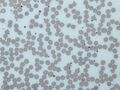
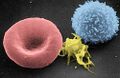
Platelets, also known as thrombocytes, are small, colorless cell fragments in our blood that form clots and stop or prevent bleeding. Platelets are produced in our bone marrow, the spongy tissue inside our bones. Platelet count can be affected by many diseases and conditions.
Structure[edit]
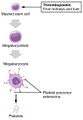
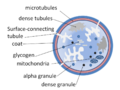
Platelets are not true cells but are actually fragments of cytoplasm, which are derived from the megakaryocytes of the bone marrow, or lung tissue in mammals. They have a diameter of 2–3 µm. Platelets do not have a cell nucleus, they are fragments of cytoplasm that are derived from the megakaryocytes of the bone marrow, and then enter the circulation.
Function[edit]
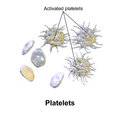
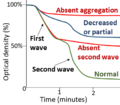
The function of platelets is to prevent bleeding. When the integrity of the blood vessels is compromised, platelets will migrate to the site and, by sticking to each other and to the walls of the blood vessel, will form a plug that prevents blood loss.
Clinical significance[edit]
Platelet disorders can lead to an increase in the number of platelets (thrombocytosis), a decrease in the number of platelets (thrombocytopenia), or an increase in the risk of clotting or bleeding. In addition to being a major component of blood clots, platelets also play a significant role in inflammation.
See also[edit]
References[edit]

This WikiMD article can only be edited by registered and verified editors. You can log in or register.
-
 Platelet
 -
 Platelet
 -
 Platelet
 -
 Platelet
 -
 Platelet
 -
 Platelet
 -
 Platelet
 -
 Platelet
 -
 Platelet
 -
 Platelet
 -
 Platelet


Medical Disclaimer: WikiMD is for informational purposes only and is not a substitute for professional medical advice. Content may be inaccurate or outdated and should not be used for diagnosis or treatment. Always consult your healthcare provider for medical decisions. Verify information with trusted sources such as CDC.gov and NIH.gov. By using this site, you agree that WikiMD is not liable for any outcomes related to its content. See full disclaimer.
Credits:Most images are courtesy of Wikimedia commons, and templates, categories Wikipedia, licensed under CC BY SA or similar.
Translate page: - East Asian
中文,
日本,
한국어,
South Asian
हिन्दी,
தமிழ்,
తెలుగు,
Urdu,
ಕನ್ನಡ,
Southeast Asian
Indonesian,
Vietnamese,
Thai,
မြန်မာဘာသာ,
বাংলা
European
español,
Deutsch,
français,
Greek,
português do Brasil,
polski,
română,
русский,
Nederlands,
norsk,
svenska,
suomi,
Italian
Middle Eastern & African
عربى,
Turkish,
Persian,
Hebrew,
Afrikaans,
isiZulu,
Kiswahili,
Other
Bulgarian,
Hungarian,
Czech,
Swedish,
മലയാളം,
मराठी,
ਪੰਜਾਬੀ,
ગુજરાતી,
Portuguese,
Ukrainian

