Three-center four-electron bond
Three-center four-electron bond (3c-4e) is a type of chemical bond in which three atoms share four electrons. This bonding model is particularly important in the description of hypervalent molecules and electron-deficient compounds. The concept is crucial for understanding the structure and bonding in species such as diborane (B2H6), certain organophosphorus compounds, and sulfur hexafluoride (SF6).
Overview[edit]
The 3c-4e bond represents a way to describe bonding situations where conventional two-center two-electron (2c-2e) bonds are insufficient. In a 3c-4e bond, two electrons occupy a bonding molecular orbital that is spread over three atomic centers, while the other two electrons occupy a corresponding antibonding orbital. Despite the presence of electrons in an antibonding orbital, the overall bonding interaction is stabilizing due to the delocalization of these electrons over three atoms.
Structure and Bonding[edit]
In a typical 3c-4e bond, the molecular orbital diagram shows that the lowest energy orbital is a bonding orbital delocalized over the three atomic centers. Above this, there is a non-bonding orbital and then an antibonding orbital. The four electrons fill the bonding and non-bonding orbitals, resulting in a net stabilizing effect.
This type of bonding is often depicted using dashed lines to indicate the partial bond character between the atoms involved. For example, in diborane, the bonds between the boron atoms and the bridging hydrogen atoms are described by 3c-4e bonds.
Examples[edit]
- Diborane (B2H6): Diborane contains two 3c-4e bonds involving the boron atoms and the bridging hydrogen atoms. These bonds are crucial for the stability and structure of diborane.
- Phosphorus pentafluoride (PF5): In PF5, the phosphorus atom forms five bonds, which can be described using 3c-4e bonding concepts to account for the hypervalency.
- Sulfur hexafluoride (SF6): Although SF6 is often described using an expanded octet model, the 3c-4e bond model provides an alternative description that avoids the need for d-orbital participation.
Significance[edit]
The concept of the 3c-4e bond is significant in the field of chemistry as it provides a more accurate description of the bonding in certain compounds that cannot be adequately described by traditional valence bond theory. It highlights the importance of electron delocalization in stabilizing compounds with electron-deficient or hypervalent centers.
See Also[edit]

-
 Molecular orbitals of triiodide
 -
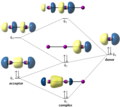 Natural bond orbitals of triiodide
 -
 Three-center four-electron bond


Medical Disclaimer: WikiMD is for informational purposes only and is not a substitute for professional medical advice. Content may be inaccurate or outdated and should not be used for diagnosis or treatment. Always consult your healthcare provider for medical decisions. Verify information with trusted sources such as CDC.gov and NIH.gov. By using this site, you agree that WikiMD is not liable for any outcomes related to its content. See full disclaimer.
Credits:Most images are courtesy of Wikimedia commons, and templates, categories Wikipedia, licensed under CC BY SA or similar.
Translate page: - East Asian
中文,
日本,
한국어,
South Asian
हिन्दी,
தமிழ்,
తెలుగు,
Urdu,
ಕನ್ನಡ,
Southeast Asian
Indonesian,
Vietnamese,
Thai,
မြန်မာဘာသာ,
বাংলা
European
español,
Deutsch,
français,
Greek,
português do Brasil,
polski,
română,
русский,
Nederlands,
norsk,
svenska,
suomi,
Italian
Middle Eastern & African
عربى,
Turkish,
Persian,
Hebrew,
Afrikaans,
isiZulu,
Kiswahili,
Other
Bulgarian,
Hungarian,
Czech,
Swedish,
മലയാളം,
मराठी,
ਪੰਜਾਬੀ,
ગુજરાતી,
Portuguese,
Ukrainian

