Thiobarbital
Thiobarbital is a type of barbiturate, a class of drugs that act as central nervous system depressants. It is primarily used in the medical field as a sedative and hypnotic drug.
History[edit]
Thiobarbital was first synthesized in the early 20th century, along with other barbiturates. It was widely used in the mid-20th century for its sedative and hypnotic effects, but its use has declined in recent years due to the development of safer alternatives.
Pharmacology[edit]
Like other barbiturates, thiobarbital works by increasing the activity of the neurotransmitter gamma-aminobutyric acid (GABA) in the brain. GABA inhibits the activity of the nervous system, leading to sedation and sleepiness. Thiobarbital also decreases the activity of the excitatory neurotransmitter glutamate.
Medical uses[edit]
Thiobarbital is used in medicine as a sedative and hypnotic drug. It is often used to induce sleep in patients with insomnia, and to sedate patients before surgery or other medical procedures. It can also be used to treat seizures in certain cases.
Side effects[edit]
Common side effects of thiobarbital include drowsiness, dizziness, and confusion. More serious side effects can include respiratory depression, addiction, and overdose. Long-term use of thiobarbital can lead to physical dependence and withdrawal symptoms.
See also[edit]

This WikiMD article can only be edited by registered and verified editors. You can log in or register.
-
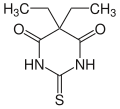 Structure of Thiobarbital
 -
 Synthesis of Thiobarbital


Medical Disclaimer: WikiMD is for informational purposes only and is not a substitute for professional medical advice. Content may be inaccurate or outdated and should not be used for diagnosis or treatment. Always consult your healthcare provider for medical decisions. Verify information with trusted sources such as CDC.gov and NIH.gov. By using this site, you agree that WikiMD is not liable for any outcomes related to its content. See full disclaimer.
Credits:Most images are courtesy of Wikimedia commons, and templates, categories Wikipedia, licensed under CC BY SA or similar.
Translate page: - East Asian
中文,
日本,
한국어,
South Asian
हिन्दी,
தமிழ்,
తెలుగు,
Urdu,
ಕನ್ನಡ,
Southeast Asian
Indonesian,
Vietnamese,
Thai,
မြန်မာဘာသာ,
বাংলা
European
español,
Deutsch,
français,
Greek,
português do Brasil,
polski,
română,
русский,
Nederlands,
norsk,
svenska,
suomi,
Italian
Middle Eastern & African
عربى,
Turkish,
Persian,
Hebrew,
Afrikaans,
isiZulu,
Kiswahili,
Other
Bulgarian,
Hungarian,
Czech,
Swedish,
മലയാളം,
मराठी,
ਪੰਜਾਬੀ,
ગુજરાતી,
Portuguese,
Ukrainian

