Thermistor
A Thermistor is a type of resistor whose resistance is dependent on temperature, more so than in standard resistors. The word is a portmanteau of thermal and resistor. Thermistors are widely used as inrush current limiters, temperature sensors (negative temperature coefficient or NTC type typically), self-resetting overcurrent protectors, and self-regulating heating elements (positive temperature coefficient or PTC type typically).
Types of Thermistors[edit]
Thermistors can be classified into two types, depending on the sign of k. If k is positive, the resistance increases with increasing temperature, and the device is called a positive temperature coefficient (PTC) thermistor, or posistor. If k is negative, the resistance decreases with increasing temperature, and the device is called a negative temperature coefficient (NTC) thermistor.
Positive Temperature Coefficient (PTC) Thermistors[edit]
Positive Temperature Coefficient (PTC) Thermistors are thermistors whose resistance increases when the temperature increases. PTC thermistors are commonly installed in series with a circuit, and used to protect against overcurrent conditions, as resettable fuses.
Negative Temperature Coefficient (NTC) Thermistors[edit]
Negative Temperature Coefficient (NTC) Thermistors are thermistors whose resistance decreases when the temperature increases. NTC thermistors are commonly used in a range of applications such as temperature sensing and inrush current limiting.
Applications[edit]
Thermistors, both PTC and NTC, are used in a variety of applications. These include temperature sensors, inrush current limiters, self-resetting overcurrent protectors, and self-regulating heating elements.
See Also[edit]
- Resistor
- Temperature Coefficient
- Inrush Current Limiter
- Overcurrent Protection
- Self-Regulating Heating Element
References[edit]

This WikiMD article can only be edited by registered and verified editors. You can log in or register.
-
 NTC bead thermistor
 -
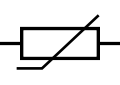 Thermistor diagram
 -
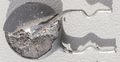 Failed NTC thermistor


Medical Disclaimer: WikiMD is for informational purposes only and is not a substitute for professional medical advice. Content may be inaccurate or outdated and should not be used for diagnosis or treatment. Always consult your healthcare provider for medical decisions. Verify information with trusted sources such as CDC.gov and NIH.gov. By using this site, you agree that WikiMD is not liable for any outcomes related to its content. See full disclaimer.
Credits:Most images are courtesy of Wikimedia commons, and templates, categories Wikipedia, licensed under CC BY SA or similar.
Translate page: - East Asian
中文,
日本,
한국어,
South Asian
हिन्दी,
தமிழ்,
తెలుగు,
Urdu,
ಕನ್ನಡ,
Southeast Asian
Indonesian,
Vietnamese,
Thai,
မြန်မာဘာသာ,
বাংলা
European
español,
Deutsch,
français,
Greek,
português do Brasil,
polski,
română,
русский,
Nederlands,
norsk,
svenska,
suomi,
Italian
Middle Eastern & African
عربى,
Turkish,
Persian,
Hebrew,
Afrikaans,
isiZulu,
Kiswahili,
Other
Bulgarian,
Hungarian,
Czech,
Swedish,
മലയാളം,
मराठी,
ਪੰਜਾਬੀ,
ગુજરાતી,
Portuguese,
Ukrainian

