Tetrameric protein
Tetrameric proteins are a class of multimeric proteins that consist of four subunits. These subunits may be identical, as in a homotetramer, or different, as in a heterotetramer. Tetrameric proteins play crucial roles in various biological processes, including structural support, enzyme catalysis, and the regulation of cellular activities. The quaternary structure of tetrameric proteins allows for complex regulation and functionality that is not possible with monomeric proteins.
Structure and Function[edit]
The structure of a tetrameric protein is determined by the arrangement and interaction of its four subunits. These interactions are critical for the protein's stability and function. The subunits in a tetrameric protein can be arranged in various configurations, which are often described by their symmetry. For example, a tetramer with four identical subunits that are symmetrically arranged is referred to as a homotetramer. Hemoglobin, an oxygen-transport protein found in red blood cells, is a well-known example of a heterotetramer, consisting of two alpha and two beta subunits.
Tetrameric proteins are involved in a wide range of biological functions. For instance, they can serve as enzymes, facilitating biochemical reactions with high specificity and efficiency. They also play a role in the structural integrity of cells and organisms, as well as in the transmission of signals within and between cells.
Examples of Tetrameric Proteins[edit]
- Hemoglobin: Transports oxygen from the lungs to the rest of the body and carbon dioxide back to the lungs to be exhaled.
- Pyruvate kinase: An enzyme involved in glycolysis, catalyzing the transfer of a phosphate group from phosphoenolpyruvate to ADP, producing ATP.
- Ion channels: Such as the potassium channels, which are crucial for maintaining the cell's membrane potential.
Regulation[edit]
The activity of tetrameric proteins can be regulated through several mechanisms, including allosteric regulation, where the binding of a molecule at one site affects the activity at another site, and post-translational modifications such as phosphorylation. These regulatory mechanisms allow cells to respond dynamically to changes in their environment or internal state.
Clinical Significance[edit]
Mutations or dysregulation of tetrameric proteins can lead to diseases. For example, mutations in the genes encoding the subunits of hemoglobin can result in sickle cell disease or thalassemia, which affect the protein's ability to transport oxygen. Understanding the structure and function of tetrameric proteins is therefore crucial for developing therapeutic strategies for these and other conditions.
Research and Techniques[edit]
Studying tetrameric proteins involves a variety of biochemical and biophysical techniques, including X-ray crystallography, nuclear magnetic resonance (NMR) spectroscopy, and cryo-electron microscopy (cryo-EM). These techniques allow scientists to determine the structures of tetrameric proteins at atomic resolution, providing insights into their function and regulation.
.svg) | This biochemistry article is a stub. You can help WikiMD by expanding the page. |
-
 Monomer, Dimer, Tetramer of SDH
 -
Beta-Glucuronidase Homotetramer
-
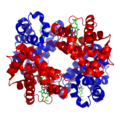 Haemoglobin Tetramer


Medical Disclaimer: WikiMD is for informational purposes only and is not a substitute for professional medical advice. Content may be inaccurate or outdated and should not be used for diagnosis or treatment. Always consult your healthcare provider for medical decisions. Verify information with trusted sources such as CDC.gov and NIH.gov. By using this site, you agree that WikiMD is not liable for any outcomes related to its content. See full disclaimer.
Credits:Most images are courtesy of Wikimedia commons, and templates, categories Wikipedia, licensed under CC BY SA or similar.
Translate page: - East Asian
中文,
日本,
한국어,
South Asian
हिन्दी,
தமிழ்,
తెలుగు,
Urdu,
ಕನ್ನಡ,
Southeast Asian
Indonesian,
Vietnamese,
Thai,
မြန်မာဘာသာ,
বাংলা
European
español,
Deutsch,
français,
Greek,
português do Brasil,
polski,
română,
русский,
Nederlands,
norsk,
svenska,
suomi,
Italian
Middle Eastern & African
عربى,
Turkish,
Persian,
Hebrew,
Afrikaans,
isiZulu,
Kiswahili,
Other
Bulgarian,
Hungarian,
Czech,
Swedish,
മലയാളം,
मराठी,
ਪੰਜਾਬੀ,
ગુજરાતી,
Portuguese,
Ukrainian


