Tetrahymena
Tetrahymena is a genus of free-living ciliates that can be found in a variety of aquatic environments. The genus contains around forty species, but the exact number is not certain as the group is not well-studied. Tetrahymena species are used as model organisms in biomedical research. They are particularly important in the study of the function of cilia and the process of phagocytosis.
Characteristics[edit]
Tetrahymena cells are pear-shaped and are covered with cilia. They have two types of nuclei: a large macronucleus and one or more small micronuclei. The macronucleus controls the non-reproductive cell functions, while the micronucleus is responsible for genetic recombination during sexual reproduction.
Reproduction[edit]
Tetrahymena reproduce both sexually and asexually. In sexual reproduction, two cells of different mating types fuse together and exchange micronuclei. In asexual reproduction, the macronucleus divides and the cell splits in two.
Use in research[edit]
Tetrahymena are used in research because they are easy to grow in the laboratory and have a number of features that make them useful for studying basic biological processes. For example, they were used in the discovery of telomeres and telomerase, for which the 2009 Nobel Prize in Physiology or Medicine was awarded.
See also[edit]
References[edit]
External links[edit]

This WikiMD article can only be edited by registered and verified editors. You can log in or register.
-
 Tetrahymena thermophila
 -
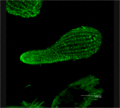 Tetrahymena Beta Tubulin
 -
 Tetrahymena research
 -
 Tetrahymena conjugation
 -
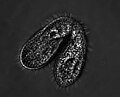 Mating Tetrahymena


Medical Disclaimer: WikiMD is for informational purposes only and is not a substitute for professional medical advice. Content may be inaccurate or outdated and should not be used for diagnosis or treatment. Always consult your healthcare provider for medical decisions. Verify information with trusted sources such as CDC.gov and NIH.gov. By using this site, you agree that WikiMD is not liable for any outcomes related to its content. See full disclaimer.
Credits:Most images are courtesy of Wikimedia commons, and templates, categories Wikipedia, licensed under CC BY SA or similar.
Translate page: - East Asian
中文,
日本,
한국어,
South Asian
हिन्दी,
தமிழ்,
తెలుగు,
Urdu,
ಕನ್ನಡ,
Southeast Asian
Indonesian,
Vietnamese,
Thai,
မြန်မာဘာသာ,
বাংলা
European
español,
Deutsch,
français,
Greek,
português do Brasil,
polski,
română,
русский,
Nederlands,
norsk,
svenska,
suomi,
Italian
Middle Eastern & African
عربى,
Turkish,
Persian,
Hebrew,
Afrikaans,
isiZulu,
Kiswahili,
Other
Bulgarian,
Hungarian,
Czech,
Swedish,
മലയാളം,
मराठी,
ਪੰਜਾਬੀ,
ગુજરાતી,
Portuguese,
Ukrainian

