Taxus baccata
Taxus baccata is a species of evergreen tree in the yew family, Taxaceae, native to western, central and southern Europe, northwest Africa, northern Iran and southwest Asia. It is the tree originally known as yew, though with other related trees becoming known, it may now be known as English yew, or European yew.
Description[edit]
Taxus baccata is a large evergreen tree, growing up to 20–40 m tall, with a trunk up to 2 m diameter. The bark is thin, scaly brown, coming off in small flakes aligned with the stem. The leaves are lanceolate, flat, dark green, 1–4 cm long and 2–3 mm broad, arranged spirally on the stem, but with the leaf bases twisted to align the leaves in two flat rows either side of the stem.
Distribution and habitat[edit]
Taxus baccata is native to Europe, northwest Africa, northern Iran and southwest Asia. It is most commonly found in the wild on limestone soils. The most northerly stand of ancient yews in Britain is on limestone at Ravensdale, County Louth in Ireland.
Uses[edit]
The wood of Taxus baccata is hard and durable. It has been used for cabinet work and for the longbows of English archers. The foliage and seeds are used to produce the anti-cancer drug paclitaxel.
Toxicity[edit]
All parts of a yew plant are toxic to humans with the exception of the yew berries (however, their seeds are toxic); furthermore, its foliage is also toxic to horses, cattle, and dogs.
Conservation[edit]
Taxus baccata is currently listed as a species of least concern by the IUCN Red List. However, it is one of the species that is likely to be affected by climate change, and efforts are being made to ensure its survival.
See also[edit]
References[edit]
| Taxus species | ||||
|---|---|---|---|---|
This Taxus related articles is a stub.
|
 | This tree-related article is a stub. You can help WikiMD by expanding the page. |
 | This medical article is a stub. You can help WikiMD by expanding the page. |
-
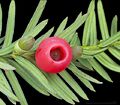 Taxus baccata
 -
Taxus baccata
-
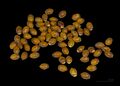 Taxus baccata
 -
Taxus baccata
-
Taxus baccata
-
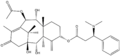 Taxus baccata
 -
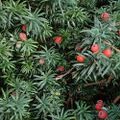 Taxus baccata
 -
 Taxus baccata
 -
Taxus baccata
-
Taxus baccata
-
Taxus baccata


Medical Disclaimer: WikiMD is for informational purposes only and is not a substitute for professional medical advice. Content may be inaccurate or outdated and should not be used for diagnosis or treatment. Always consult your healthcare provider for medical decisions. Verify information with trusted sources such as CDC.gov and NIH.gov. By using this site, you agree that WikiMD is not liable for any outcomes related to its content. See full disclaimer.
Credits:Most images are courtesy of Wikimedia commons, and templates, categories Wikipedia, licensed under CC BY SA or similar.
Translate page: - East Asian
中文,
日本,
한국어,
South Asian
हिन्दी,
தமிழ்,
తెలుగు,
Urdu,
ಕನ್ನಡ,
Southeast Asian
Indonesian,
Vietnamese,
Thai,
မြန်မာဘာသာ,
বাংলা
European
español,
Deutsch,
français,
Greek,
português do Brasil,
polski,
română,
русский,
Nederlands,
norsk,
svenska,
suomi,
Italian
Middle Eastern & African
عربى,
Turkish,
Persian,
Hebrew,
Afrikaans,
isiZulu,
Kiswahili,
Other
Bulgarian,
Hungarian,
Czech,
Swedish,
മലയാളം,
मराठी,
ਪੰਜਾਬੀ,
ગુજરાતી,
Portuguese,
Ukrainian


