Tarsometatarsus
Tarsometatarsus is a unique skeletal structure found in the lower legs of birds and some non-avian dinosaurs. This bone is formed by the fusion of the tarsals and metatarsals, a characteristic feature of the avian skeletal system. The tarsometatarsus serves as a critical component in the bird's ability to walk and run efficiently.
Structure[edit]
The tarsometatarsus is a long, slender bone that forms the lower part of the bird's leg, between the tibiotarsus and the digits. It is composed of the distal tarsal bones fused with the metatarsal bones. This fusion results in a rigid structure that provides support and leverage for the bird's foot. The tarsometatarsus is typically longer in bird species that are adapted for running or wading, such as ostriches and flamingos.
Function[edit]
The primary function of the tarsometatarsus is to provide support and leverage for the bird's foot during locomotion. The rigidity of the tarsometatarsus allows for efficient transfer of force from the leg muscles to the foot, enabling birds to walk, run, and jump with great agility and speed. Additionally, the tarsometatarsus plays a role in the bird's balance and stability.
Evolution[edit]
The tarsometatarsus is believed to have evolved in response to the demands of flight. The fusion of the tarsal and metatarsal bones resulted in a more streamlined and lightweight limb, which would have been advantageous for flight. Fossil evidence suggests that the tarsometatarsus was present in early bird ancestors, such as Archaeopteryx and theropod dinosaurs.
See also[edit]

 | This medical article is a stub. You can help WikiMD by expanding the page. |
-
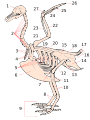 Diagram of a bird skeleton
 -
 Heterodontosaurus skeleton
 -
 Hydropathy plot of Arylsulfatase B


Medical Disclaimer: WikiMD is for informational purposes only and is not a substitute for professional medical advice. Content may be inaccurate or outdated and should not be used for diagnosis or treatment. Always consult your healthcare provider for medical decisions. Verify information with trusted sources such as CDC.gov and NIH.gov. By using this site, you agree that WikiMD is not liable for any outcomes related to its content. See full disclaimer.
Credits:Most images are courtesy of Wikimedia commons, and templates, categories Wikipedia, licensed under CC BY SA or similar.
Translate page: - East Asian
中文,
日本,
한국어,
South Asian
हिन्दी,
தமிழ்,
తెలుగు,
Urdu,
ಕನ್ನಡ,
Southeast Asian
Indonesian,
Vietnamese,
Thai,
မြန်မာဘာသာ,
বাংলা
European
español,
Deutsch,
français,
Greek,
português do Brasil,
polski,
română,
русский,
Nederlands,
norsk,
svenska,
suomi,
Italian
Middle Eastern & African
عربى,
Turkish,
Persian,
Hebrew,
Afrikaans,
isiZulu,
Kiswahili,
Other
Bulgarian,
Hungarian,
Czech,
Swedish,
മലയാളം,
मराठी,
ਪੰਜਾਬੀ,
ગુજરાતી,
Portuguese,
Ukrainian

