Talk:United Kingdom
Template:Skip to talk Template:Talk header Template:FAQ Template:British English Template:Article history Template:WikiProject banner shell Template:Press Template:Other banners Template:Section sizes Talk:United Kingdom/archivebox User:MiszaBot/configUser:HBC Archive Indexerbot/OptIn
Extended-confirmed-protected edit request on 6 March 2026[edit]
Template:Edit extended-protected Change citation [o]
From The United Kingdom does not have a codified constitution but an unwritten one formed of Acts of Parliament, court judgments, traditions, and conventions
To The United Kingdom has an uncodified constitution formed of Acts of Parliament, court judgments, traditions, and conventions
Per the current UCL citation ([1]) and supported by other RS ([2]), it "is not strictly correct" to describe the UK constitution as "unwritten", "it is largely written, but in different documents".
Acts of Parliament, court judgements and conventions are 'written down', but the constitution remains uncodified. Saiga Antelope (talk) 11:53, 6 March 2026 (UTC)
 Not done for now

: I considered this but came up with two tentative reasons not to, yet.
- The documents of which the constitution is composed are written, of course, but is there a written document spelling out which of those is considered constitutional in nature? One that incorporates the relevant Acts of Parliament, court judgments, traditions, and conventions by reference?
- When I turned to the footnotes I first noticed citation [s], which reads Template:Tq, demonstrating the usual convention of calling the UK constitution unwritten. That interpretation and the one made by your sources appear to be at odds over what "unwritten" means in this usage of the word. I don't know which is the predominate interpretation in relevant literature, and that matters in terms of what we have written here. At the least, it would seem weird to have [o] state one thing and [s] to aver the opposite. I think we should have others chime in here and try to reach a consensus for changing it before we do. Largoplazo (talk) 13:33, 6 March 2026 (UTC)
- Thanks for the response- I also support seeking consensus. However, I would still like to suggest that the UK constitution is not 'unwritten'.
- Let me outline my arguments below for anyone else who turns up.
- TLDR: The UK constitution is 'partly written and wholly uncodified'. To say that the UK constitution is unwritten is, at best, misleading and, at worst, incorrect. As authoritative RS indicate (like Parliament's website), the UK constitution is largely, and possibly entirely, written down but it is not codified in a single document. This distinction is important because it conveys the trend in recent history (e.g. Human Rights Act 1998 and Constitutional Reform Act 2005) of placing a few major documents at the heart of the UK constitution. Pragmatically, we should make the simple and straightforward change to the term 'uncodified' to be more accurate and reduce confusion.
- 1) Convention
- A simple google search will return RS explaining that the term unwritten is inaccurate.
- Whilst historically it may have more accurate to describe the UK constitution (e.g. 17th Century) as 'unwritten', authorities on this matter, including this other page on the parliamentary website make it clear that the term unwritten is now inaccurate. The best explanation I have found comes from that page; 'People often refer to the UK having an 'unwritten constitution' but that's not strictly true... Therefore, the UK constitution is often described as 'partly written and wholly uncodified'. (Uncodified means that the UK does not have a single, written constitution.)'
- 2) Semantic
- For the reasons outlined above, it is accurate to describe the UK constitution as not wholly written, but this does not mean unwritten. There is a fundamental difference between 'not being a written (implying codified) constitution' (per Sunkin's quote) and being 'unwritten'. This might seem pedantic, but it's an important distinction; the UK constitution is not all written, but it is not unwritten.
- 3) Pragmatic
- The whole problem can be avoided by using 'uncodified'. Not once in the Constitution of the United Kingdom article does it describe the constitution as 'unwritten'.
- We can agree that 'uncodified' is clearly correct. Given that a number of reliable sources (including both the one already cited in the article and Parliament's own website) challenge the accuracy of 'unwritten', from a practical perspective, it is better to use 'uncodified' than 'unwritten' as it avoids the ambiguity outright.
- Sorry for the spam :) Saiga Antelope (talk) 15:41, 7 March 2026 (UTC)
- Template:Tq: A simple Google search for what?
- If reliable sources in general term it "unwritten", we say it's "unwritten". We go by the preponderance of reliable sources, not our own analysis of whether the sources are accurate. Largoplazo (talk) 17:05, 7 March 2026 (UTC)
- If reliable sources in general term it "unwritten", we say it's "unwritten"- I don't think they do though.
- I think that the most reliable sources do not support the term 'unwritten' without context.
- I don't want to get into an argument, but this is not what I am saying. I am saying that academic sources prefer the term 'uncodified'. It is not my opinion or my analysis. I have linked clear RS like Parliament's own website.
- Also per WP:RS, the idea that we shouldn't use "our own analysis of whether the sources are accurate" doesn't mean we shouldn't weigh up the credibility of sources. WP:RS states that "in case of a dispute, editors need to be able to explain why they relied on that source".
- UCL- What is the UK constitution?
- I won't say anything more, because I want to be constructive and, in the end, it's a minor issue :) Saiga Antelope (talk) 09:04, 8 March 2026 (UTC)
 3O Response: "Parliament's own website" is not an independent source. It would be necessary to show that a substantial majority of independent sources agree. There is not such a demonstration here, so the edit should not be made at this time. To gain support for the edit, show a substantial quantity of independent sources that support the proposition. "Just go google it" is never an acceptable source; you are required to "google it" and cite the specific sources you find. Seraphimblade Talk to me 13:40, 29 March 2026 (UTC)
- Thanks for the 3O- I will now drop the stick.
- Here is a compilation of sources for anyone who might show up:
- If you have to read just one read this- https://www.ft.com/content/06181ee0-2279-4d77-b8d6-3500dd5389d8
- https://www.ucl.ac.uk/social-historical-sciences/constitution-unit/constitution-unit-publications/constitution-unit-explainers/what-uk-constitution
- https://www.parliament.uk/about/how/role/sovereignty/
- https://commonslibrary.parliament.uk/research-briefings/cbp-9384/
- https://citizen-network.org/library/why-uk-needs-a-written-constitution.html
- https://newsroom.northumbria.ac.uk/pressreleases/expert-comment-a-written-constitution-for-the-uk-would-not-have-resolved-recent-brexit-arguments-heres-why-2936374
- https://recordoflaw.in/understanding-the-uks-uncodified-constitution/
- https://www.lawteacher.net/free-law-essays/public-law/with-reference-to-the-uncodified-law-essays.php
- https://blogs.kcl.ac.uk/kslr/2014/01/14/should-britain-adopt-a-written-constitution/
- Whatever the case (even if I'm wrong) someone needs to change the citation. Because currently the footnote's citation (https://www.ucl.ac.uk/social-historical-sciences/constitution-unit/constitution-unit-publications/constitution-unit-explainers/what-uk-constitution) which says 'unwritten' is inaccurate contradicts the footnote which uses 'unwritten'. Saiga Antelope (talk) 16:42, 29 March 2026 (UTC)
Extended-confirmed-protected edit request on 7 March 2026[edit]
Template:Edit extended-protected Change: >In 1066 the Normans conquered England
To:
In 1066 the Normans conquered England and subsequently Wales and Ireland.
Or a rewording of that. Since this article deals with the United Kingdom as a whole and not just England it makes sense to focus on the Normans role in the whole British Isles' history and not just England. Thanks. ~2026-71794-6 (talk) 10:57, 7 March 2026 (UTC)
 Not done
: This is in the lead, which is a quick run-through of the highlights. The details, which cover the arrival of the Normans in Wales, Ireland, and Scotland, are in the history section. Largoplazo (talk) 13:37, 7 March 2026 (UTC)
Extended-confirmed-protected edit request on 17 March 2026[edit]
Template:Edit extended-protected The Lands name needs switching to Blairite United Kingdom as the UK is basically run by Tony Blair and according to his diktats that are globalist EU driven and migrant friendly in nature to the detriment of the Folk. ~2026-16717-80 (talk) 08:22, 17 March 2026 (UTC)
- Not done for now: please establish a consensus for this alteration before posting an edit request. ScrubbedFalcon (talk) 09:08, 17 March 2026 (UTC)
Ethnic pie chart[edit]
This gif is a bit misleading. It comes across that the White category is 76.8% in 2021, but the text next to it says the Whites are "83 per cent". I believe this is because it adds the "White Other" category (which is 6.2%). So although it seems accurate, it gives the impression that the White population has gone down proportionally more than it actually has. I do not know if there is a solution but I still see it as a tad misleading. الدبوني (talk) 17:18, 22 March 2026 (UTC)
- I've always thought that for accessibility reasons, these pie charts are a worse option than a table. Cordless Larry (talk) 17:55, 22 March 2026 (UTC)
- @Cordless Larry: I agree, even more so as this is an animation and therefore inaccessible to some readers; so I've been bold and deleted the chart. If [a] static pie chart[s] is/are needed, then {{Pie chart}} is more accessible and maintainable. Bazza 7 (talk) 19:30, 22 March 2026 (UTC)
- "inaccessible to some readers" and quantifying 'some' here is? And the reasons for which? The file is 935kb which is smaller than multiple files on here already (1, 2, 3, 4 etc.) and I haven't dropped down dead yet for it to not be 'maintainable'! - Tweedle (talk) 16:40, 28 March 2026 (UTC)
- I don't think we should be presenting data in animations as it likely makes it inaccessible to those using screen readers. I also don't see how these charts are compatible with MOS:ANIMATION. Cordless Larry (talk) 16:55, 28 March 2026 (UTC)
- OK so that's not alot of people, but let's just concede the point anyway. The only rule break with MOS:ANIMATION is that it's over 5 seconds by being 21 seconds, but you are going to get that on anything that shows statistics over a considerable period because if I had done it any quicker people would accuse me of "rushing it" and then it being "misleading" as a result. I don't see that much of a reason personally for removal and it's been in the article for over a year without any complaints relating to this.
- I object to adding the table that was in last time in again because it was poorly done by only splitting the Asian category (why not the others? Or for that matter none?) and only showed two census years (or presumbly three now that 2021/2022 can be added? I don't know how it would have been done). I would not be opposed to adding in the table that exists on Demographics of the United Kingdom, even in a condensed format which just showed Whites, Asians, Blacks, Mixed and Other from 1981 to 2021 but then I still feel the graphic is better for illustrating a time series, in fact the Ethnicity section there exists for that purpose (illustrating total detailed population numbers over time). Tweedle (talk) 17:59, 28 March 2026 (UTC)
- I don't think we should be presenting data in animations as it likely makes it inaccessible to those using screen readers. I also don't see how these charts are compatible with MOS:ANIMATION. Cordless Larry (talk) 16:55, 28 March 2026 (UTC)
- "inaccessible to some readers" and quantifying 'some' here is? And the reasons for which? The file is 935kb which is smaller than multiple files on here already (1, 2, 3, 4 etc.) and I haven't dropped down dead yet for it to not be 'maintainable'! - Tweedle (talk) 16:40, 28 March 2026 (UTC)
- @Cordless Larry: I agree, even more so as this is an animation and therefore inaccessible to some readers; so I've been bold and deleted the chart. If [a] static pie chart[s] is/are needed, then {{Pie chart}} is more accessible and maintainable. Bazza 7 (talk) 19:30, 22 March 2026 (UTC)
- "a bit misleading" It's not, and if your issue was the fact that the text and the infobox (the last time somebody did this they got reverted..) doesn't split the White category into White British/Irish and then Other Whites like the gif does then you could have just changed this around? I feel this is a bit of a silly complaint when people can clearly infer from the graphic what the total White percentage is over time. I haven't hid Other Whites with 'Other' or whatnot! Tweedle (talk) 16:41, 28 March 2026 (UTC)
Update first sentence to identify UK as an Island Country[edit]
The first sentence of this article should be updated to describe the United Kingdom as "an Island country" to bring it in line with other island countries, such as Japan and New Zealand. Alternatively, it could be considered an Archipelagic state. Brettopia (talk) 02:46, 9 April 2026 (UTC)
- That seems to make sense, the only thing is the UK has a significant land border with Ireland. Japan for instance has no land borders with any other country. I'm not sure if that would get in the way of this definition. The republic of Ireland is not described as an Island country, neither is Indonesia. The UK also has many territories abroad with land borders, such as in Cyprus, which might also complicate the definition. Chattenoir (talk) 04:58, 9 April 2026 (UTC)
- It's not an island country, as it borders the Republic of Ireland. -- GoodDay (talk) 10:09, 9 April 2026 (UTC)
- This is a perennial topic on this talk page. See also:
- Discussion from September 2010, consensus to add "island country"
- Discussion from February 2011, consensus to remove "island country"
- RFC in October 2022 where "island country" was mentioned in the discussion a bit but not really part of the RFC itself
- Discussion from November 2023, consensus to remove "island country", citing the RFC above
- Discussion from June 2024, no consensus
- My view is that the majority of UK citizens would identify their country to be an island country. But Wikipedia has a very narrow definition of that term, which I personally think is a bit daft. My view is that both the UK and Ireland are island countries because mainland Britain and mainland Ireland are on islands as opposed to part of the European mainland. The fact they share a land border doesn't change that. Island country says "An island country, island state, or island nation is a country whose primary territory consists of one or more islands or parts of islands" and that describes the UK perfectly. WaggersTALK 10:28, 9 April 2026 (UTC)
- Actually even the definition which is used as the in-line source in the first sentence of the Island country article, https://www.collinsdictionary.com/dictionary/english/island-nation , uses Britain as an example of an Island nation! Chattenoir (talk) 10:47, 9 April 2026 (UTC)
- Island nation, yes, but too many qualifications, so leave the lead alone and don't add something for the sake of it that is relatively unimportant. Roger 8 Roger (talk) 10:50, 9 April 2026 (UTC)
- What? Chattenoir (talk) 10:52, 9 April 2026 (UTC)
- Being an island nation is a big part of Britain's cultural identity. Obviously what's important or not is fairly subjective but in my opinion it's an important definining characteristic. WaggersTALK 07:56, 13 April 2026 (UTC)
- Island nation, yes, but too many qualifications, so leave the lead alone and don't add something for the sake of it that is relatively unimportant. Roger 8 Roger (talk) 10:50, 9 April 2026 (UTC)
- Actually even the definition which is used as the in-line source in the first sentence of the Island country article, https://www.collinsdictionary.com/dictionary/english/island-nation , uses Britain as an example of an Island nation! Chattenoir (talk) 10:47, 9 April 2026 (UTC)
- This is a perennial topic on this talk page. See also:
https://en.wikipedia.org/wiki/ISO_639-3 Shockcorabo (talk) 23:39, 9 April 2026 (UTC)
Extended-confirmed-protected edit request on 12 April 2026[edit]
Template:Edit extended-protected We should change the flag to the 3:5 ratio used on land; the 1:2 ratio is used at sea only Epicazowski (talk) 22:51, 12 April 2026 (UTC)
- It is true that there is a 3:5 ratio version, however why would this be the one to use just because it's flown on land?
- From the sources I have seen neither is more official than the other and it's use depends on context, the 3:5 version is apparently used at the UN.
- Perhaps both could be displayed in the infobox. Chattenoir (talk) 00:02, 13 April 2026 (UTC)
- It's a tricky thing because, according to these sources at least 1 2, the UK is the only country in the world whose flag has zero basis in law. There is no official flag at all. Chattenoir (talk) 00:06, 13 April 2026 (UTC)
- Not done for now: please establish a consensus for this alteration before posting an edit request. Day Creature (talk) 00:16, 13 April 2026 (UTC)
- Will do - Epicazowski (talk) 00:22, 13 April 2026 (UTC)
Ratio of flag[edit]
As @Epicazowski has pointed out, it's a little odd that the 1:2 ratio of the flag is used in the infobox.
I propose adding two flags to the infobox using the second flag option, one in 1:2 and one in 3:5. Neither are official and have become a national flag through precedent not law, and there neither of the two common ratios are more official than the other. Despite traditionally being flown at sea the 1:2 ratio is often flown on land on flagpoles, where as the 3:5 ratio is often used by the Government. We could have both in the infobox with the caption: Left: The union flag in 1:2 ratio. Right: A 3:5 ratio. Neither is official.
Otherwise we should decide whether to use the 1:2 or 3:5. Has this been discussed before I wonder? Chattenoir (talk) 00:36, 13 April 2026 (UTC)
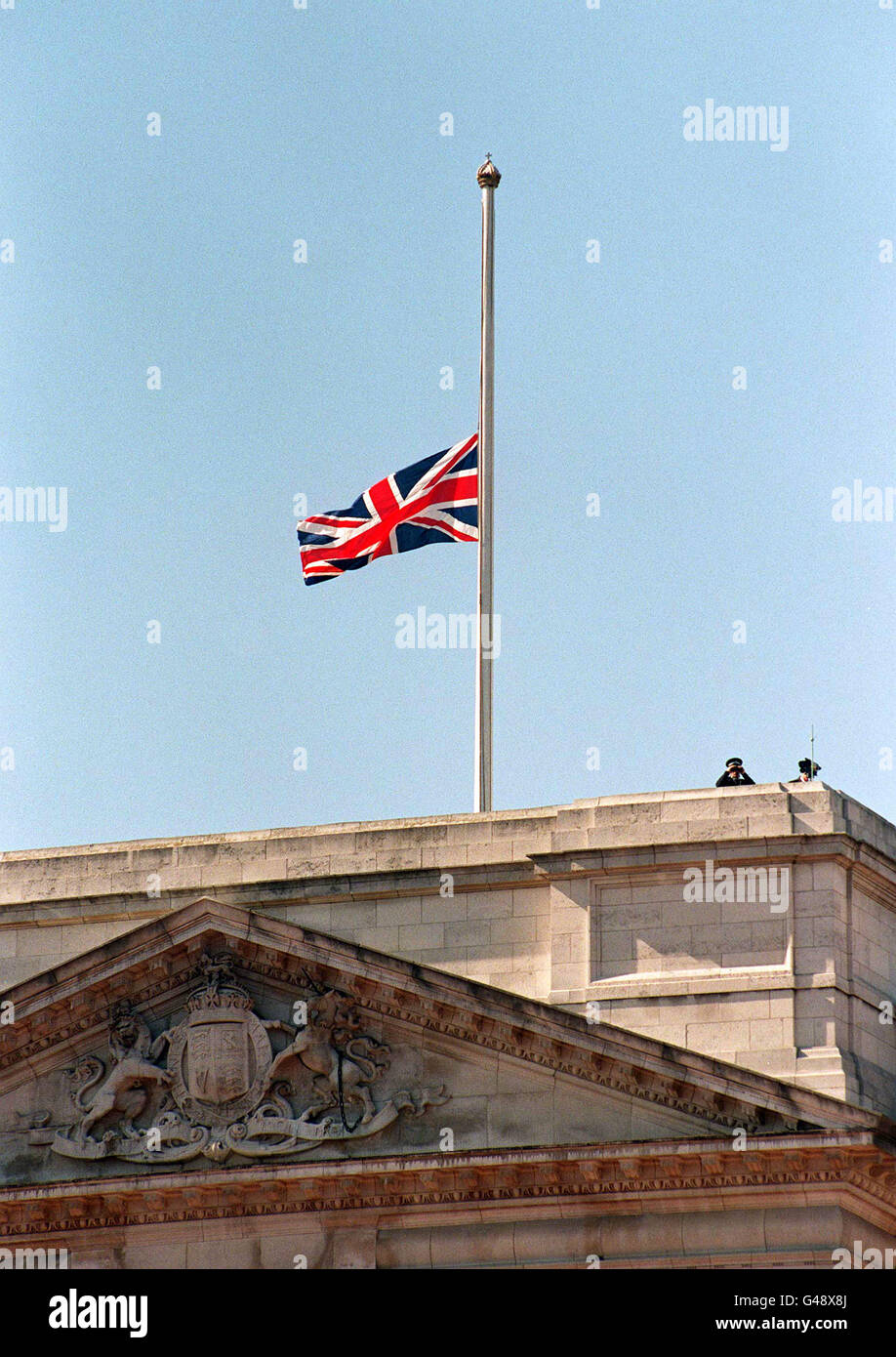
- As you have pointed out, usage is so mixed that I don't think it matters much which is shown. However, Buckingham Palace, the Palace of Westminster and UK Government buildings all use 1:2 as standard, even on land:
- 1:2 has also become the standard for most Commonwealth flags because they were originally created by the Admiralty, and the flags which have replaced the blue and red ensigns tend to have stuck to the 1:2 ratio. So the Flag Institute's battle to have 3:5 accepted as a standard ratio on land may be doomed. The Flags of the World website has an interesting discussion about it here: FOTW
- In light of the above, I don't think it necessary to include both ratios on the UK article. If a reader is particularly interested in the flag, there's a link right below it where they can read all about it. Dgp4004 (talk) 06:23, 13 April 2026 (UTC)
"Vereinigtes Königreich" listed at Redirects for discussion[edit]
 The redirect Vereinigtes Königreich has been listed at redirects for discussion to determine whether its use and function meets the redirect guidelines. Readers of this page are welcome to comment on this redirect at Wikipedia:Redirects for discussion/Log/2026 April 18 § Vereinigtes Königreich until a consensus is reached. A1Cafel (talk) 04:32, 18 April 2026 (UTC)
Government[edit]
Wouldn't the government of the United Kingdom (or at least England) be a theocracy because the ruling monarch is also the supreme governor of the Church of England? Leierkasten II (talk) 13:46, 22 April 2026 (UTC)
- British law doesn't claim to be based on pronouncements from God and the government's leaders don't claim to be God's representatives or to be running the country according to the dictates of God or of the Church of England. The last prime minister was Hindu. Largoplazo (talk) 14:31, 22 April 2026 (UTC)
Extended-confirmed-protected edit request on 24 April 2026[edit]
Template:Edit extended-protected Please update the sentence in the Economy section from:
“The United Kingdom has a highly developed social market economy.[257][258] With an estimated nominal GDP of £2.765 trillion in 2024,[259] it is the sixth-largest national economy in the world and the second-largest in Europe”
to:
“The United Kingdom has a highly developed social market economy.[257][258] With an estimated nominal GDP of £2.819 trillion in 2025,[3] it is the fifth-largest national economy in the world and the second-largest in Europe.”
Reason: The current sentence uses an older IMF nominal GDP figure. The IMF World Economic Outlook Data Explorer gives a 2025 UK nominal GDP of 2,818.929 billion in domestic currency, which is about £2.819 trillion.
Using the IMF nominal GDP data, the UK ranks fifth rather than sixth.[4] In current U.S. dollars, the IMF data places the UK ahead of India, and the 2025 historical data already show this: 4,003.022 billion U.S. dollars for the UK versus 3,916.312 billion for India.[5]
This change mainly reflects exchange rate movements, because the ranking is based on nominal GDP in current U.S. dollars. Rather than a dramatic change in the underlying economic outlook of either the UK or India. Nonetheless, using the IMF’s nominal GDP measure, the UK is now the fifth-largest national economy in the world, so the article should reflect that.
For consistency, the related article Economy of the United Kingdom already uses the updated IMF figures and lists the UK as the 5th-largest economy by nominal GDP. Tatra T3 (talk) 01:52, 24 April 2026 (UTC)
"Regno Unito" listed at Redirects for discussion[edit]
The redirect Regno Unito has been listed at redirects for discussion to determine whether its use and function meets the redirect guidelines. Readers of this page are welcome to comment on this redirect at Wikipedia:Redirects for discussion/Log/2026 April 25 § Regno Unito until a consensus is reached. A1Cafel (talk) 04:01, 25 April 2026 (UTC)
- ↑ https://www.ucl.ac.uk/social-historical-sciences/constitution-unit/constitution-unit-publications/constitution-unit-explainers/what-uk-constitution
- ↑ https://commonslibrary.parliament.uk/research-briefings/cbp-9384/
- ↑ https://data.imf.org/en/Data-Explorer?datasetUrn=IMF.RES:WEO(9.0.0)
- ↑ https://www.imf.org/external/datamapper/NGDPD@WEO/OEMDC/ADVEC/WEOWORLD/GBR/IND
- ↑ https://data.imf.org/en/Data-Explorer?datasetUrn=IMF.RES:WEO(9.0.0)