Syringa vulgaris
Syringa vulgaris, also known as the common lilac, is a species of flowering plant in the Oleaceae family. It is native to the Balkan Peninsula, where it grows on rocky hills. This species is widely cultivated as an ornamental and has been naturalized in other parts of Europe, as well as North America.
Description[edit]
Syringa vulgaris is a large deciduous shrub or small tree, growing to a height of 6–7 m. The leaves are simple, heart-shaped, and arranged oppositely on the stems. The flowers are produced in spring and are arranged in dense, terminal panicles. They are fragrant, with a scent that is often described as one of the defining fragrances of the season.
Cultivation[edit]
Syringa vulgaris is a popular ornamental plant in gardens and parks, due to its attractive, fragrant flowers. It is also used in the cut flower industry. The plant is hardy and can tolerate a range of soil types, but prefers well-drained, loamy soil. It is also tolerant of urban pollution, and will even thrive in inner city environments.
Varieties[edit]
There are numerous varieties of Syringa vulgaris, many of them developed for the horticultural trade. These include 'Alba', a white-flowered variety; 'Charles Joly', a double magenta variety; and 'Firmament', a single blue variety.
Uses[edit]
In addition to its use as an ornamental plant, Syringa vulgaris has a number of other uses. The wood is hard and dense, and can be used for engraving or musical instruments. The flowers are edible and can be used to flavor food and drink.
Cultural significance[edit]
The common lilac is a symbol of love in many cultures. In Greece, it is associated with the ancient festival of Pan, the god of forests and fields. In Russia, holding a sprig of lilac over the newborn would bring wisdom.

This flora-related article is a stub. You can help WikiMD by expanding it.
-
Syringa vulgaris
-
Syringa vulgaris
-
Syringa vulgaris
-
Syringa vulgaris
-
Syringa vulgaris
-
Syringa vulgaris
-
Syringa vulgaris
-
Syringa vulgaris
-
Syringa vulgaris
-
Syringa vulgaris
-
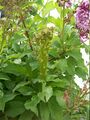 Syringa vulgaris
 -
Syringa vulgaris

Sponsored Health Resource

W8MD Weight Loss, Sleep & MedSpa
Looking for physician-supervised weight loss, semaglutide, tirzepatide, or GLP-1 receptor agonist options? W8MD helps eligible patients in New York City, Brooklyn, New Jersey, Connecticut, Pennsylvania, Delaware, and greater Philadelphia with medical weight loss, sleep medicine, and long-term maintenance support.
GLP-1 specials: Affordable GLP-1 injections NYC and Philadelphia starting from $29.99/week and up for semaglutide with insurance accepted for qualifying visits, and $45/week and up for tirzepatide with insurance accepted for qualifying visits. Self-pay options start from $59.99/week and up for semaglutide and $69.99/week and up for tirzepatide.
- Medical weight loss NYC
- Affordable GLP-1 injections NYC
- Budget GLP-1 weight loss shots Philadelphia
- New Jersey medical weight loss
- NYC medical weight loss blog
- Philadelphia weight loss blog
- Sleep medicine and sleep apnea services
- W8MD MedSpa and wellness
Book a W8MD appointment · View GLP-1 specials
Paid promotional message. Eligibility, pricing, insurance coverage, medication availability, and results vary. Medical evaluation required.

Medical Disclaimer: WikiMD is for informational purposes only and is not a substitute for professional medical advice. Content may be inaccurate or outdated and should not be used for diagnosis or treatment. Always consult your healthcare provider for medical decisions. Verify information with trusted sources such as CDC.gov and NIH.gov. By using this site, you agree that WikiMD is not liable for any outcomes related to its content. See full disclaimer.
Credits:Most images are courtesy of Wikimedia commons, and templates, categories Wikipedia, licensed under CC BY SA or similar.
Translate page: - East Asian
中文,
日本,
한국어,
South Asian
हिन्दी,
தமிழ்,
తెలుగు,
Urdu,
ಕನ್ನಡ,
Southeast Asian
Indonesian,
Vietnamese,
Thai,
မြန်မာဘာသာ,
বাংলা
European
español,
Deutsch,
français,
Greek,
português do Brasil,
polski,
română,
русский,
Nederlands,
norsk,
svenska,
suomi,
Italian
Middle Eastern & African
عربى,
Turkish,
Persian,
Hebrew,
Afrikaans,
isiZulu,
Kiswahili,
Other
Bulgarian,
Hungarian,
Czech,
Swedish,
മലയാളം,
मराठी,
ਪੰਜਾਬੀ,
ગુજરાતી,
Portuguese,
Ukrainian


.jpg)


