Swiss-type cheeses
Swiss-type cheeses are a group of cheeses that originated in Switzerland, but are now produced in many other countries. They are known for their distinctive holes or "eyes", which are formed during the fermentation process. Swiss-type cheeses are typically hard or semi-hard, with a firm texture and a mild, nutty flavor.
History[edit]
The production of Swiss-type cheeses dates back to the early Middle Ages, when Swiss farmers began to develop their own methods of cheese-making. The first Swiss-type cheeses were likely made in the Canton of Bern, which is still known for its cheese production today.
Production[edit]
Swiss-type cheeses are made from cow's milk, which is heated and combined with rennet and bacteria to start the fermentation process. The cheese is then pressed into molds and aged for several months. The distinctive holes in Swiss-type cheeses are caused by carbon dioxide gas, which is produced by the bacteria during fermentation.
Varieties[edit]
There are many different varieties of Swiss-type cheeses, including:
- Emmental: This is the most well-known Swiss-type cheese, often simply referred to as "Swiss cheese" in the United States. It has a mild, slightly sweet flavor and large holes.
- Gruyère: This cheese has a slightly stronger flavor than Emmental, with smaller holes. It is often used in cooking, particularly in dishes like fondue and quiche.
- Appenzeller: This cheese is known for its spicy, tangy flavor, which is achieved by washing the cheese with a mixture of wine and spices during the aging process.
- Raclette: This cheese is traditionally melted and scraped onto potatoes and other foods. It has a creamy texture and a strong, pungent flavor.
Health benefits[edit]
Swiss-type cheeses are a good source of protein, calcium, and vitamin B12. They are also lower in fat and sodium than many other types of cheese, making them a healthier choice for those watching their diet.
See also[edit]
 | This cheese-related article is a stub. You can help WikiMD by expanding the page. |

-
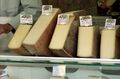 Swiss-type_cheeses
 -
Swiss-type_cheeses
-
Swiss-type_cheeses
-
Swiss-type_cheeses
-
Swiss-type_cheeses
-
Swiss-type_cheeses
-
Swiss-type_cheeses
-
Swiss-type_cheeses
-
Swiss-type_cheeses
-
Swiss-type_cheeses
-
Swiss-type_cheeses
-
Swiss-type_cheeses


Medical Disclaimer: WikiMD is for informational purposes only and is not a substitute for professional medical advice. Content may be inaccurate or outdated and should not be used for diagnosis or treatment. Always consult your healthcare provider for medical decisions. Verify information with trusted sources such as CDC.gov and NIH.gov. By using this site, you agree that WikiMD is not liable for any outcomes related to its content. See full disclaimer.
Credits:Most images are courtesy of Wikimedia commons, and templates, categories Wikipedia, licensed under CC BY SA or similar.
Translate page: - East Asian
中文,
日本,
한국어,
South Asian
हिन्दी,
தமிழ்,
తెలుగు,
Urdu,
ಕನ್ನಡ,
Southeast Asian
Indonesian,
Vietnamese,
Thai,
မြန်မာဘာသာ,
বাংলা
European
español,
Deutsch,
français,
Greek,
português do Brasil,
polski,
română,
русский,
Nederlands,
norsk,
svenska,
suomi,
Italian
Middle Eastern & African
عربى,
Turkish,
Persian,
Hebrew,
Afrikaans,
isiZulu,
Kiswahili,
Other
Bulgarian,
Hungarian,
Czech,
Swedish,
മലയാളം,
मराठी,
ਪੰਜਾਬੀ,
ગુજરાતી,
Portuguese,
Ukrainian


.jpg)
.jpg)
.jpg)
.jpg)
.jpg)
.jpg)
.jpg)
.jpg)