Chicory
Chicory (Cichorium intybus) is a perennial herbaceous plant of the Asteraceae family. It is native to Europe, but is now also found in other parts of the world. The plant has a long history of cultivation, dating back to ancient Egypt, where it was used for medicinal and culinary purposes.
Description[edit]
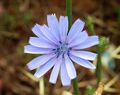
Chicory grows to a height of 30 to 100 cm. It has a deep taproot and a rosette of leaves at the base of the stem. The leaves are toothed, and can be up to 30 cm long. The flowers are blue, and have a diameter of about 2 cm. They bloom in mid-summer and continue until early fall.
Culinary use[edit]
Chicory leaves are used in salads, and can also be cooked like spinach. The leaves have a slightly bitter taste, which can be reduced by blanching them before use. The roots of the chicory plant are roasted and ground, and used as a coffee substitute or additive.
In addition to its culinary uses, chicory is also used as a natural medicine. The plant contains compounds that are believed to have anti-inflammatory and antioxidant properties.
History[edit]
Chicory has a long history of cultivation, dating back to ancient Egypt, where it was grown as a medicinal herb. It was later introduced to Europe, where it became a popular food and beverage ingredient.
During the 19th century, chicory was widely used as a coffee substitute in Europe, especially during times of coffee shortages or rationing. The roots of the plant were roasted, ground, and mixed with coffee to extend the supply. Today, chicory is still used as a coffee substitute or additive in some parts of the world.
Health benefits[edit]
Chicory is a good source of vitamins and minerals, including vitamins A, C, and K, as well as calcium, potassium, and iron. It also contains inulin, a type of dietary fiber that has been shown to have health benefits such as improving digestive health and reducing blood sugar levels.
Some studies suggest that chicory may also have anti-inflammatory and antioxidant properties, which could make it beneficial for preventing or treating certain health conditions. However, more research is needed to fully understand the potential health benefits of chicory.
Varieties[edit]
There are several varieties of chicory, including endive and radicchio. Endive is a leafy vegetable that is commonly used in salads, while radicchio is a red-leafed variety of chicory that is often used in Italian cuisine.
Cultivation[edit]
Chicory is a hardy plant that can grow in a wide range of soil types and climates. It is often grown as a winter crop in temperate regions, and can be harvested from late fall until early spring. The plant is propagated by seed, and can be grown from both direct seeding and transplanting.
Gallery[edit]
-
Chicory seeds
-
 Radicchio di Castelfranco, a variety of chicory

In popular culture[edit]
Chicory has been referenced in various works of literature and popular culture. In the classic novel Adventures of Huckleberry Finn by Mark Twain, the character Huck Finn and his friend Tom Sawyer add chicory root to their tobacco to make it taste better. The plant has also been mentioned in several songs, including "Chicory Blue" by Paul Simon and "The Chicory" by John Prine.
See also[edit]

Medical Disclaimer: WikiMD is for informational purposes only and is not a substitute for professional medical advice. Content may be inaccurate or outdated and should not be used for diagnosis or treatment. Always consult your healthcare provider for medical decisions. Verify information with trusted sources such as CDC.gov and NIH.gov. By using this site, you agree that WikiMD is not liable for any outcomes related to its content. See full disclaimer.
Credits:Most images are courtesy of Wikimedia commons, and templates, categories Wikipedia, licensed under CC BY SA or similar.
Translate page: - East Asian
中文,
日本,
한국어,
South Asian
हिन्दी,
தமிழ்,
తెలుగు,
Urdu,
ಕನ್ನಡ,
Southeast Asian
Indonesian,
Vietnamese,
Thai,
မြန်မာဘာသာ,
বাংলা
European
español,
Deutsch,
français,
Greek,
português do Brasil,
polski,
română,
русский,
Nederlands,
norsk,
svenska,
suomi,
Italian
Middle Eastern & African
عربى,
Turkish,
Persian,
Hebrew,
Afrikaans,
isiZulu,
Kiswahili,
Other
Bulgarian,
Hungarian,
Czech,
Swedish,
മലയാളം,
मराठी,
ਪੰਜਾਬੀ,
ગુજરાતી,
Portuguese,
Ukrainian


