Submandibular space
Submandibular space is a fascial space of the head and neck (also termed fascial spaces or tissue spaces). It is a potential space and can become an actual space if disease or infection progresses in the facial tissues. The submandibular space is located below the mandible and is continuous with the sublingual space on its superior aspect.
Etymology[edit]
The term "submandibular" is derived from the Latin words "sub" meaning under and "mandibula" meaning jawbone.
Anatomy[edit]
The submandibular space is a potential space that is located below the mandible. It is bordered by the mylohyoid muscle inferiorly, the hyoglossus muscle and middle constrictor muscle medially, and the mandible laterally. The space is divided into superficial and deep parts by the mylohyoid muscle. The superficial part is located between the mylohyoid muscle and the skin, while the deep part is located between the mylohyoid muscle and the hyoglossus muscle.
Clinical significance[edit]
Infections in the submandibular space can lead to a condition known as Ludwig's angina, which is a type of cellulitis that can be life-threatening. The infection can spread to other fascial spaces of the neck and can cause difficulty in breathing, swallowing, and speaking. Treatment typically involves antibiotics and sometimes surgical intervention to drain the infection.
Related terms[edit]
- Sublingual space: A fascial space of the head and neck that is located above the mylohyoid muscle and is continuous with the submandibular space.
- Ludwig's angina: A type of cellulitis that can occur due to an infection in the submandibular space.
- Cellulitis: A bacterial skin infection that can spread to the submandibular space and other fascial spaces of the neck.

This WikiMD article can only be edited by registered and verified editors. You can log in or register.
-
 Submandibular space (gray507 edit)
 -
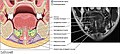 Submandibular and sublingual space
 -
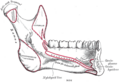 Submandibular space
 -
 Submandibular space (Gray386 edit)
.png)


.png)

Medical Disclaimer: WikiMD is for informational purposes only and is not a substitute for professional medical advice. Content may be inaccurate or outdated and should not be used for diagnosis or treatment. Always consult your healthcare provider for medical decisions. Verify information with trusted sources such as CDC.gov and NIH.gov. By using this site, you agree that WikiMD is not liable for any outcomes related to its content. See full disclaimer.
Credits:Most images are courtesy of Wikimedia commons, and templates, categories Wikipedia, licensed under CC BY SA or similar.
Translate page: - East Asian
中文,
日本,
한국어,
South Asian
हिन्दी,
தமிழ்,
తెలుగు,
Urdu,
ಕನ್ನಡ,
Southeast Asian
Indonesian,
Vietnamese,
Thai,
မြန်မာဘာသာ,
বাংলা
European
español,
Deutsch,
français,
Greek,
português do Brasil,
polski,
română,
русский,
Nederlands,
norsk,
svenska,
suomi,
Italian
Middle Eastern & African
عربى,
Turkish,
Persian,
Hebrew,
Afrikaans,
isiZulu,
Kiswahili,
Other
Bulgarian,
Hungarian,
Czech,
Swedish,
മലയാളം,
मराठी,
ਪੰਜਾਬੀ,
ગુજરાતી,
Portuguese,
Ukrainian

