Split pea
Split pea is a type of legume, specifically a variety of the pea grown specifically for drying. Split peas are high in protein and fiber, and are often used in soups and stews.
History[edit]
Split peas have a long history of cultivation dating back thousands of years. They were a staple food in the ancient civilizations of Egypt, Greece, and Rome. In the Middle Ages, they became a common food in Europe, particularly in the colder northern regions where they could be stored for long periods.
Cultivation[edit]
Split peas are grown in many parts of the world, but the largest producers are Canada, France, and China. They are typically sown in the spring and harvested in the late summer or early fall. The peas are then dried and split along a natural seam, hence the name "split pea."
Nutritional Value[edit]
Split peas are a rich source of protein, fiber, and several important vitamins and minerals. They are low in fat and contain no cholesterol, making them a healthy choice for those following a vegetarian or vegan diet.
Culinary Uses[edit]
Split peas are most commonly used in the preparation of soup, particularly split pea soup, which is a traditional dish in many cultures. They can also be used in stews, salads, and side dishes. In Indian cuisine, split peas are often used to make dal, a type of thick, spicy stew.
See Also[edit]

-
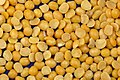 Split pea
 -
 A sack of split peas awaits distribution at a joint WFP ACTED site in central Bamako, Mali

.jpg)
Ad. Transform your life with W8MD's
GLP-1 weight loss injections special from $29.99 with insurance
|
WikiMD Medical Encyclopedia |
Medical Disclaimer: WikiMD is not a substitute for professional medical advice. The information on WikiMD is provided as an information resource only, may be incorrect, outdated or misleading, and is not to be used or relied on for any diagnostic or treatment purposes. Please consult your health care provider before making any healthcare decisions or for guidance about a specific medical condition. WikiMD expressly disclaims responsibility, and shall have no liability, for any damages, loss, injury, or liability whatsoever suffered as a result of your reliance on the information contained in this site. By visiting this site you agree to the foregoing terms and conditions, which may from time to time be changed or supplemented by WikiMD. If you do not agree to the foregoing terms and conditions, you should not enter or use this site. See full disclaimer.
Credits:Most images are courtesy of Wikimedia commons, and templates, categories Wikipedia, licensed under CC BY SA or similar.
Translate this page: - East Asian
中文,
日本,
한국어,
South Asian
हिन्दी,
தமிழ்,
తెలుగు,
Urdu,
ಕನ್ನಡ,
Southeast Asian
Indonesian,
Vietnamese,
Thai,
မြန်မာဘာသာ,
বাংলা
European
español,
Deutsch,
français,
Greek,
português do Brasil,
polski,
română,
русский,
Nederlands,
norsk,
svenska,
suomi,
Italian
Middle Eastern & African
عربى,
Turkish,
Persian,
Hebrew,
Afrikaans,
isiZulu,
Kiswahili,
Other
Bulgarian,
Hungarian,
Czech,
Swedish,
മലയാളം,
मराठी,
ਪੰਜਾਬੀ,
ગુજરાતી,
Portuguese,
Ukrainian
