Social stratification
Social stratification refers to the categorization of people in a society into different ranks based on their socio-economic conditions. It is a characteristic of society, not just a reflection of individual differences. Social stratification is a complex system that includes many different variables, such as wealth, education, occupation, and power.
Definition[edit]
Social stratification is a sociological phenomenon in which people in society are ranked into a hierarchy of statuses that are associated with unequal rewards and privileges. This ranking is determined by various factors such as wealth, occupation, education, and power. The concept of social stratification is closely related to social inequality, as it is the structured form of social inequality within a society.
Theories of Social Stratification[edit]
There are several theories that attempt to explain social stratification, including the functionalist, conflict, and symbolic interactionist perspectives.
Functionalist Perspective[edit]
The functionalist perspective, associated with Émile Durkheim and Talcott Parsons, argues that social stratification is necessary and beneficial to society. It suggests that the system of stratification works to maintain the stability and integration of society.
Conflict Perspective[edit]
The conflict perspective, associated with Karl Marx, argues that social stratification benefits the rich and powerful at the expense of the poor. This perspective views social stratification as a source of conflict and instability.
Symbolic Interactionist Perspective[edit]
The symbolic interactionist perspective, associated with George Herbert Mead, focuses on the micro-level interactions and how they can lead to social stratification. It suggests that social stratification is maintained through individuals' daily interactions and perceptions.
Forms of Social Stratification[edit]
There are several forms of social stratification, including caste, class, and elite-mass dichotomy systems.
Caste System[edit]
The Caste system is a form of social stratification in which people's statuses are determined by birth and are lifelong. This system is most commonly associated with India.
Class System[edit]
The class system is a form of social stratification based on economic status. People in a class system can move up or down in the social hierarchy through changes in their wealth or occupation.
Elite-Mass Dichotomy System[edit]
The elite-mass dichotomy system is a form of social stratification that divides society into a small elite and the larger mass of people. This system is associated with the work of Vilfredo Pareto and Gaetano Mosca.
See Also[edit]
 | This sociology-related article is a stub. You can help WikiMD by expanding the page. |
Social stratification[edit]
-
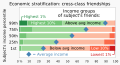 Economic stratification - cross-class friendships
 -
 Pyramid of Capitalist System


Medical Disclaimer: WikiMD is for informational purposes only and is not a substitute for professional medical advice. Content may be inaccurate or outdated and should not be used for diagnosis or treatment. Always consult your healthcare provider for medical decisions. Verify information with trusted sources such as CDC.gov and NIH.gov. By using this site, you agree that WikiMD is not liable for any outcomes related to its content. See full disclaimer.
Credits:Most images are courtesy of Wikimedia commons, and templates, categories Wikipedia, licensed under CC BY SA or similar.
Translate page: - East Asian
中文,
日本,
한국어,
South Asian
हिन्दी,
தமிழ்,
తెలుగు,
Urdu,
ಕನ್ನಡ,
Southeast Asian
Indonesian,
Vietnamese,
Thai,
မြန်မာဘာသာ,
বাংলা
European
español,
Deutsch,
français,
Greek,
português do Brasil,
polski,
română,
русский,
Nederlands,
norsk,
svenska,
suomi,
Italian
Middle Eastern & African
عربى,
Turkish,
Persian,
Hebrew,
Afrikaans,
isiZulu,
Kiswahili,
Other
Bulgarian,
Hungarian,
Czech,
Swedish,
മലയാളം,
मराठी,
ਪੰਜਾਬੀ,
ગુજરાતી,
Portuguese,
Ukrainian

