Snell's law
Snell's Law is a formula used in Physics to describe the relationship between the angles of incidence and refraction, when referring to light or other waves passing through a boundary between two different isotropic media, such as water, glass, or air.
History[edit]
The law is named after the Dutch astronomer Willebrord Snellius (1580–1626), but was first accurately described by the Persian scientist Ibn Sahl in 984. The law follows from the principle of least time, which in turn follows from the principle of relativity.
Mathematical Formulation[edit]
In its simplest form, Snell's Law states that the ratio of the sine of the angle of incidence to the sine of the angle of refraction is equivalent to the ratio of the velocity of light in the original medium to the velocity of light in the refracting medium. This can be written as:
- n1 * sin(θ1) = n2 * sin(θ2)
where:
- n1 and n2 are the refractive indices of the first and second media respectively,
- θ1 is the angle between the incident ray and the surface normal (the line perpendicular to the surface at the point of incidence),
- θ2 is the angle between the refracted ray and the surface normal.
Applications[edit]
Snell's Law is used in many areas of physics, including in fiber optics, underwater diving, and optics. It is also essential in the design of lenses and prisms.
See Also[edit]
References[edit]
 | This physics-related article is a stub. You can help WikiMD by expanding the page. |
Snell's law[edit]
-
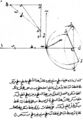 Ibn Sahl's manuscript on optics


Medical Disclaimer: WikiMD is for informational purposes only and is not a substitute for professional medical advice. Content may be inaccurate or outdated and should not be used for diagnosis or treatment. Always consult your healthcare provider for medical decisions. Verify information with trusted sources such as CDC.gov and NIH.gov. By using this site, you agree that WikiMD is not liable for any outcomes related to its content. See full disclaimer.
Credits:Most images are courtesy of Wikimedia commons, and templates, categories Wikipedia, licensed under CC BY SA or similar.
Translate page: - East Asian
中文,
日本,
한국어,
South Asian
हिन्दी,
தமிழ்,
తెలుగు,
Urdu,
ಕನ್ನಡ,
Southeast Asian
Indonesian,
Vietnamese,
Thai,
မြန်မာဘာသာ,
বাংলা
European
español,
Deutsch,
français,
Greek,
português do Brasil,
polski,
română,
русский,
Nederlands,
norsk,
svenska,
suomi,
Italian
Middle Eastern & African
عربى,
Turkish,
Persian,
Hebrew,
Afrikaans,
isiZulu,
Kiswahili,
Other
Bulgarian,
Hungarian,
Czech,
Swedish,
മലയാളം,
मराठी,
ਪੰਜਾਬੀ,
ગુજરાતી,
Portuguese,
Ukrainian

