Size-exclusion chromatography
Size-exclusion chromatography (SEC), also known as gel filtration chromatography, is a chromatographic method in which molecules in solution are separated by their size, and in some cases molecular weight, through a column filled with a porous stationary phase. SEC is widely used in both analytical and preparative applications, ranging from the purification of large biomolecules such as proteins and nucleic acids to the analysis of small molecules in complex mixtures.
Principle[edit]
The principle of size-exclusion chromatography relies on the differential partitioning of components in a sample between a mobile phase (solvent) and a stationary phase (a column packed with porous particles). Molecules larger than the pores of the stationary phase cannot enter the pores and are eluted from the column first. Smaller molecules, however, can enter the pores and are retained for longer periods within the column, leading to their later elution. Thus, separation is achieved based on the size of the molecules, with larger molecules eluting before smaller ones.
Components[edit]
Stationary Phase[edit]
The stationary phase in SEC consists of a column packed with porous beads made from materials such as agarose, dextran, or polyacrylamide. The choice of material and the pore size of the beads are critical factors that determine the separation range and efficiency of the chromatography.
Mobile Phase[edit]
The mobile phase is the solvent that carries the sample through the column. It is chosen based on the compatibility with the sample and the stationary phase. Common solvents include water, buffer solutions, and organic solvents for non-aqueous applications.
Applications[edit]
Size-exclusion chromatography is utilized in various fields for different purposes:
- In biochemistry, SEC is used for the purification and analysis of proteins, nucleic acids, and other biomolecules.
- In polymer science, it helps in determining the molecular weight distribution of polymers.
- SEC is also employed in the food industry for the analysis of polysaccharides and other macromolecules.
Advantages and Limitations[edit]
Advantages[edit]
- SEC is a gentle separation technique, making it suitable for the purification of sensitive biological molecules.
- It allows for the separation of molecules based on size, independent of their ionic strength or hydrophobicity.
Limitations[edit]
- SEC does not provide information about the molecular structure or composition.
- The resolution of SEC is generally lower than that of other chromatographic techniques, such as high-performance liquid chromatography (HPLC).
See Also[edit]
References[edit]

-
 ÄKTA Pure size-exclusion chromatography systems
 -
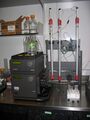 Size-exclusion chromatography apparatus
 -
 Superdex 200HR gel filtration column
 -
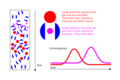 Size-exclusion chromatography
 -
 Size-exclusion chromatography standardisation
 -
 Size-exclusion chromatography


Medical Disclaimer: WikiMD is for informational purposes only and is not a substitute for professional medical advice. Content may be inaccurate or outdated and should not be used for diagnosis or treatment. Always consult your healthcare provider for medical decisions. Verify information with trusted sources such as CDC.gov and NIH.gov. By using this site, you agree that WikiMD is not liable for any outcomes related to its content. See full disclaimer.
Credits:Most images are courtesy of Wikimedia commons, and templates, categories Wikipedia, licensed under CC BY SA or similar.
Translate page: - East Asian
中文,
日本,
한국어,
South Asian
हिन्दी,
தமிழ்,
తెలుగు,
Urdu,
ಕನ್ನಡ,
Southeast Asian
Indonesian,
Vietnamese,
Thai,
မြန်မာဘာသာ,
বাংলা
European
español,
Deutsch,
français,
Greek,
português do Brasil,
polski,
română,
русский,
Nederlands,
norsk,
svenska,
suomi,
Italian
Middle Eastern & African
عربى,
Turkish,
Persian,
Hebrew,
Afrikaans,
isiZulu,
Kiswahili,
Other
Bulgarian,
Hungarian,
Czech,
Swedish,
മലയാളം,
मराठी,
ਪੰਜਾਬੀ,
ગુજરાતી,
Portuguese,
Ukrainian

