Serpiginous
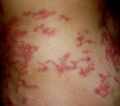
Serpiginous is a term used in medicine to describe a lesion or physical finding that has a serpentine or snake-like appearance. This term is often used in dermatology to describe the physical appearance of skin lesions.
Definition[edit]
The term "serpiginous" is derived from the Latin word "serpigo", which means "creeping". In medical terminology, it is used to describe a lesion or physical finding that has a creeping, snakelike appearance. This can be seen in various medical conditions, including certain skin diseases, parasitic infections, and vascular disorders.
Clinical Significance[edit]
Serpiginous lesions are often seen in conditions such as cutaneous larva migrans, a parasitic skin infection caused by hookworm larvae. These lesions are characterized by their winding, snake-like appearance, which is caused by the movement of the larvae under the skin.
Other conditions that may present with serpiginous lesions include Lyme disease, tuberculosis, and certain types of vasculitis. In these conditions, the serpiginous appearance of the lesions is due to the pattern of inflammation or infection in the skin or underlying tissues.
Diagnosis and Treatment[edit]
The diagnosis of conditions presenting with serpiginous lesions is often based on the clinical appearance of the lesions, along with the patient's history and other clinical findings. Additional tests, such as skin biopsies or blood tests, may be needed to confirm the diagnosis.
Treatment of serpiginous lesions depends on the underlying cause. For example, cutaneous larva migrans is typically treated with antiparasitic medications, while conditions like vasculitis may require immunosuppressive therapy.
See Also[edit]

This WikiMD article can only be edited by registered and verified editors. You can log in or register.
-
 Serpiginous


Medical Disclaimer: WikiMD is for informational purposes only and is not a substitute for professional medical advice. Content may be inaccurate or outdated and should not be used for diagnosis or treatment. Always consult your healthcare provider for medical decisions. Verify information with trusted sources such as CDC.gov and NIH.gov. By using this site, you agree that WikiMD is not liable for any outcomes related to its content. See full disclaimer.
Credits:Most images are courtesy of Wikimedia commons, and templates, categories Wikipedia, licensed under CC BY SA or similar.
Translate page: - East Asian
中文,
日本,
한국어,
South Asian
हिन्दी,
தமிழ்,
తెలుగు,
Urdu,
ಕನ್ನಡ,
Southeast Asian
Indonesian,
Vietnamese,
Thai,
မြန်မာဘာသာ,
বাংলা
European
español,
Deutsch,
français,
Greek,
português do Brasil,
polski,
română,
русский,
Nederlands,
norsk,
svenska,
suomi,
Italian
Middle Eastern & African
عربى,
Turkish,
Persian,
Hebrew,
Afrikaans,
isiZulu,
Kiswahili,
Other
Bulgarian,
Hungarian,
Czech,
Swedish,
മലയാളം,
मराठी,
ਪੰਜਾਬੀ,
ગુજરાતી,
Portuguese,
Ukrainian

