Cutaneous horn

Editor-In-Chief: Prab R Tumpati, MD
Obesity, Sleep & Internal medicine
Founder, WikiMD Wellnesspedia &
W8MD's weight loss doctor NYC
Philadelphia GLP-1 weight loss and GLP-1 clinic NYC
| Cutaneous horn | |
|---|---|
 | |
| Synonyms | Cornu cutaneum |
| Pronounce | N/A |
| Specialty | N/A |
| Symptoms | Hard, conical projection on the skin |
| Complications | Squamous cell carcinoma, basal cell carcinoma, melanoma |
| Onset | Varies |
| Duration | Persistent until treated |
| Types | N/A |
| Causes | Actinic keratosis, wart, seborrheic keratosis, keratoacanthoma |
| Risks | Sun exposure, human papillomavirus infection |
| Diagnosis | Physical examination, biopsy |
| Differential diagnosis | Wart, actinic keratosis, seborrheic keratosis, keratoacanthoma |
| Prevention | N/A |
| Treatment | Surgical excision, cryotherapy, curettage |
| Medication | N/A |
| Prognosis | Good with treatment |
| Frequency | Rare |
| Deaths | N/A |
Cutaneous horn is a type of skin lesion that resembles the horn of an animal. It is a conical, dense, and hyperkeratotic protrusion that can vary in size from a few millimeters to several centimeters. Cutaneous horns are most commonly found in areas exposed to sunlight, such as the face, ear, and back of the hands.
Causes[edit]
Cutaneous horns are caused by the overgrowth of the top layer of skin, known as the epidermis. This overgrowth can be triggered by a variety of factors, including sun damage, human papillomavirus (HPV), and certain skin conditions such as actinic keratosis and seborrheic keratosis. In rare cases, cutaneous horns can be associated with skin cancer.
Symptoms[edit]
The primary symptom of a cutaneous horn is a hard, thickened area of skin that protrudes outward. The horn may be yellow, brown, or gray in color, and its surface may be smooth or rough. Some people may experience pain or discomfort, especially if the horn is located in an area that is frequently touched or rubbed.
Diagnosis[edit]
Diagnosis of a cutaneous horn is typically made through a physical examination. In some cases, a biopsy may be performed to rule out underlying conditions such as skin cancer.
Treatment[edit]
Treatment for cutaneous horns typically involves removing the horn and the underlying cause. This can be done through various methods, including cryotherapy, surgery, or topical medications. In cases where the horn is associated with skin cancer, additional treatments such as radiation therapy or chemotherapy may be necessary.
Prevention[edit]
Prevention of cutaneous horns involves protecting the skin from sun damage. This can be achieved by wearing protective clothing, using sunscreen, and avoiding excessive sun exposure.
Gallery[edit]
-
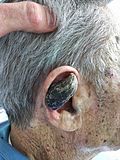 Cutaneous horn
 -
 Cutaneous horn
 -
 Cutaneous horn
 -
 Cutaneous horn
 -
 Cutaneous horn


See also[edit]


Ad. Transform your health with W8MD Weight Loss, Sleep & MedSpa

Tired of being overweight?
Special offer:
Budget GLP-1 weight loss medications
- Semaglutide starting from $29.99/week and up with insurance for visit of $59.99 and up per week self pay.
- Tirzepatide starting from $45.00/week and up (dose dependent) or $69.99/week and up self pay
✔ Same-week appointments, evenings & weekends
Learn more:
- GLP-1 weight loss clinic NYC
- W8MD's NYC medical weight loss
- W8MD Philadelphia GLP-1 shots
- Philadelphia GLP-1 injections
- Affordable GLP-1 shots NYC
- Budget GLP-1 shots
|
WikiMD Medical Encyclopedia |
Medical Disclaimer: WikiMD is for informational purposes only and is not a substitute for professional medical advice. Content may be inaccurate or outdated and should not be used for diagnosis or treatment. Always consult your healthcare provider for medical decisions. Verify information with trusted sources such as CDC.gov and NIH.gov. By using this site, you agree that WikiMD is not liable for any outcomes related to its content. See full disclaimer.
Credits:Most images are courtesy of Wikimedia commons, and templates, categories Wikipedia, licensed under CC BY SA or similar.
Translate this page: - East Asian
中文,
日本,
한국어,
South Asian
हिन्दी,
தமிழ்,
తెలుగు,
Urdu,
ಕನ್ನಡ,
Southeast Asian
Indonesian,
Vietnamese,
Thai,
မြန်မာဘာသာ,
বাংলা
European
español,
Deutsch,
français,
Greek,
português do Brasil,
polski,
română,
русский,
Nederlands,
norsk,
svenska,
suomi,
Italian
Middle Eastern & African
عربى,
Turkish,
Persian,
Hebrew,
Afrikaans,
isiZulu,
Kiswahili,
Other
Bulgarian,
Hungarian,
Czech,
Swedish,
മലയാളം,
मराठी,
ਪੰਜਾਬੀ,
ગુજરાતી,
Portuguese,
Ukrainian
