Scylla


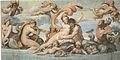
Scylla is a figure from Greek mythology, known for her role in the story of Odysseus' journey home in Homer's epic poem, the Odyssey. Scylla is depicted as a monstrous sea creature who lives on one side of a narrow channel of water, opposite her counterpart, Charybdis. The two are situated so close together that sailors attempting to avoid one would inevitably come into dangerous proximity with the other. Scylla is described as having multiple heads, each with an insatiable appetite for the sailors who venture too close to her lair.
Mythology[edit]
According to the myth, Scylla was once a beautiful nymph who was transformed into a monster due to the jealousy and actions of the sea god Poseidon's wife, Amphitrite. Various versions of the myth attribute her monstrous transformation to different gods and circumstances, but the result is always her conversion into a fearsome creature with six heads, each possessing three rows of sharp teeth. Positioned on a rock, she would snatch sailors from their ships as they attempted to navigate the narrow strait.
Scylla's story is most famously recounted in the Odyssey, where Odysseus is forced to choose between steering his ship closer to her or facing the whirlpool Charybdis. Following the advice of the sorceress Circe, Odysseus opts to pass by Scylla, resulting in the loss of six of his men to her deadly heads, a decision deemed the lesser of two evils.
In Literature and Culture[edit]
Scylla's image and story have been influential in various aspects of literature and culture, symbolizing the impossible dilemma or the choice between two evils, often referred to as being "between Scylla and Charybdis". Her depiction varies across different sources, with some emphasizing her monstrous nature, while others focus on her origins as a victim of divine jealousy and transformation.
Interpretations[edit]
The myth of Scylla and Charybdis has been interpreted in various ways, often seen as a metaphor for navigating the treacherous waters of life's decisions. Scylla, in particular, represents the more aggressively destructive of the two hazards, embodying the sudden and violent nature of the dangers that can beset those on a journey.
Legacy[edit]
The legacy of Scylla extends beyond ancient texts, influencing modern literature, art, and psychology. The term "Scylla and Charybdis" has entered the English language as an idiom for a dilemma where avoiding one risk leads to exposure to another. In psychology, the Scylla and Charybdis complex refers to a situation where an individual is caught between two opposing compulsions, each leading to a destructive outcome.
 | This mythology-related article is a stub. You can help WikiMD by expanding the page. |
-
 Scylla
 -
 Scylla
 -
 Scylla


Medical Disclaimer: WikiMD is for informational purposes only and is not a substitute for professional medical advice. Content may be inaccurate or outdated and should not be used for diagnosis or treatment. Always consult your healthcare provider for medical decisions. Verify information with trusted sources such as CDC.gov and NIH.gov. By using this site, you agree that WikiMD is not liable for any outcomes related to its content. See full disclaimer.
Credits:Most images are courtesy of Wikimedia commons, and templates, categories Wikipedia, licensed under CC BY SA or similar.
Translate page: - East Asian
中文,
日本,
한국어,
South Asian
हिन्दी,
தமிழ்,
తెలుగు,
Urdu,
ಕನ್ನಡ,
Southeast Asian
Indonesian,
Vietnamese,
Thai,
မြန်မာဘာသာ,
বাংলা
European
español,
Deutsch,
français,
Greek,
português do Brasil,
polski,
română,
русский,
Nederlands,
norsk,
svenska,
suomi,
Italian
Middle Eastern & African
عربى,
Turkish,
Persian,
Hebrew,
Afrikaans,
isiZulu,
Kiswahili,
Other
Bulgarian,
Hungarian,
Czech,
Swedish,
മലയാളം,
मराठी,
ਪੰਜਾਬੀ,
ગુજરાતી,
Portuguese,
Ukrainian

