Sautéing

Sautéing is a method of cooking that uses a small amount of oil or fat in a shallow pan over relatively high heat. Unlike pan-frying, which uses more oil and lower heat, sautéing is characterized by the use of high heat and the need to keep the food moving in the pan. The word comes from the French verb sauter, which means "to jump".
Technique[edit]
In sautéing, the food is usually cut into pieces or thinly sliced to ensure even cooking. The pan is preheated before adding the oil or fat, which should be hot enough to sear the food quickly. This method is often used for vegetables, meat, fish, and poultry.
Steps[edit]
1. **Preheat the Pan**: The pan should be heated over medium-high to high heat. 2. **Add Oil or Fat**: Once the pan is hot, add a small amount of oil or fat. Common choices include olive oil, butter, or vegetable oil. 3. **Add Food**: Place the food in the pan in a single layer to ensure even cooking. 4. **Keep it Moving**: Stir or toss the food frequently to prevent sticking and to ensure even browning. 5. **Cook Until Done**: Continue to cook until the food reaches the desired level of doneness.
Equipment[edit]
The primary piece of equipment for sautéing is a sauté pan, which has a wide, flat bottom and relatively low sides. This design allows for maximum contact between the food and the pan, facilitating even cooking and browning. A spatula or tongs are often used to turn and move the food.
Common Uses[edit]
Sautéing is a versatile technique used in many cuisines around the world. It is ideal for cooking vegetables, meat, fish, and poultry. Some common dishes that use sautéing include:
Advantages[edit]
- **Quick Cooking**: Sautéing is a fast cooking method, making it ideal for weeknight meals.
- **Flavor Development**: The high heat used in sautéing helps to develop rich, complex flavors through the Maillard reaction.
- **Versatility**: This technique can be used for a wide variety of foods and dishes.
Disadvantages[edit]
- **Risk of Burning**: The high heat used in sautéing can easily lead to burning if the food is not monitored closely.
- **Requires Attention**: Sautéing requires constant attention and frequent stirring or tossing to prevent sticking and ensure even cooking.
See Also[edit]
References[edit]
External Links[edit]
 | This article about cooking techniques is a stub. You can help WikiMD by expanding the page. |
Sautéing[edit]
-
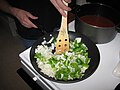 Sauté Onions and Peppers
 -
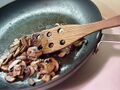 Baby Bella Mushrooms Being Sautéed
 -
 Tossing Sautéed Vegetables
 -
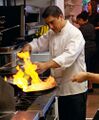 Flambé in a Sauté Pan


.jpg)

Sponsored Health Resource

W8MD Weight Loss, Sleep & MedSpa
Looking for physician-supervised weight loss, semaglutide, tirzepatide, or GLP-1 receptor agonist options? W8MD helps eligible patients in New York City, Brooklyn, New Jersey, Connecticut, Pennsylvania, Delaware, and greater Philadelphia with medical weight loss, sleep medicine, and long-term maintenance support.
GLP-1 specials: Affordable GLP-1 injections NYC and Philadelphia starting from $29.99/week and up for semaglutide with insurance accepted for qualifying visits, and $45/week and up for tirzepatide with insurance accepted for qualifying visits. Self-pay options start from $59.99/week and up for semaglutide and $69.99/week and up for tirzepatide.
Medical weight loss NYC | Affordable GLP-1 injections NYC | Budget GLP-1 weight loss shots Philadelphia | New Jersey medical weight loss | NYC medical weight loss | Philadelphia medical weight loss | Sleep clinic NYC | W8MD's Philadelphia GLP-1 doctor | Weight loss prescriptions NYC
Book a W8MD appointment · View GLP-1 specials
Paid promotional message. Eligibility, pricing, insurance coverage, medication availability, and results vary. Medical evaluation required.

Medical Disclaimer: WikiMD is for informational purposes only and is not a substitute for professional medical advice. Content may be inaccurate or outdated and should not be used for diagnosis or treatment. Always consult your healthcare provider for medical decisions. Verify information with trusted sources such as CDC.gov and NIH.gov. By using this site, you agree that WikiMD is not liable for any outcomes related to its content. See full disclaimer.
Credits:Most images are courtesy of Wikimedia commons, and templates, categories Wikipedia, licensed under CC BY SA or similar.
Translate page: - East Asian
中文,
日本,
한국어,
South Asian
हिन्दी,
தமிழ்,
తెలుగు,
Urdu,
ಕನ್ನಡ,
Southeast Asian
Indonesian,
Vietnamese,
Thai,
မြန်မာဘာသာ,
বাংলা
European
español,
Deutsch,
français,
Greek,
português do Brasil,
polski,
română,
русский,
Nederlands,
norsk,
svenska,
suomi,
Italian
Middle Eastern & African
عربى,
Turkish,
Persian,
Hebrew,
Afrikaans,
isiZulu,
Kiswahili,
Other
Bulgarian,
Hungarian,
Czech,
Swedish,
മലയാളം,
मराठी,
ਪੰਜਾਬੀ,
ગુજરાતી,
Portuguese,
Ukrainian

