Saturation diving
Saturation diving is a diving technique that allows divers to reduce the risk of decompression sickness or "the bends" when they work at great depths for long periods of time. This technique involves the divers living in a pressurized environment, which can be a diving bell or a living chamber on the surface, for the duration of the dive plus decompression time. The pressure in the living environment is matched to the pressure at the working depth. This is called saturation because the diver's tissues have absorbed the maximum partial pressure of gas possible for that depth due to the extended exposure. This is significant because once saturation is achieved, the time to decompress does not increase with further exposure.
History[edit]
The concept of saturation diving was first proposed by Albert R. Behnke in the 1940s. However, it was not until the 1960s that the technique was fully developed and used commercially. The first commercial saturation dives were performed by George F. Bond and his team at Duke University.
Technique[edit]
In saturation diving, divers breathe a gas mixture that contains helium, oxygen, and sometimes a small amount of nitrogen. The divers live and work under pressure for days or weeks at a time, returning to the surface only after a prolonged period of decompression. The divers are transported to and from the job site in a pressurized diving bell, which is mated with the living chamber on the surface.
Safety and Health Risks[edit]
While saturation diving reduces the risk of decompression sickness, it does present other health risks. These include a condition known as High Pressure Nervous Syndrome (HPNS), which can cause tremors, nausea, dizziness, and other symptoms. Long-term exposure to high pressure can also lead to a decrease in bone density.
Applications[edit]
Saturation diving is used in commercial diving, particularly in the oil and gas industry for tasks such as pipeline construction and maintenance. It is also used in scientific research and in military operations.
See Also[edit]
Saturation_diving[edit]
-
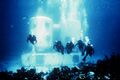 Tektite I exterior
 -
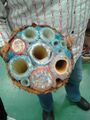 Bell umbilical section


Medical Disclaimer: WikiMD is for informational purposes only and is not a substitute for professional medical advice. Content may be inaccurate or outdated and should not be used for diagnosis or treatment. Always consult your healthcare provider for medical decisions. Verify information with trusted sources such as CDC.gov and NIH.gov. By using this site, you agree that WikiMD is not liable for any outcomes related to its content. See full disclaimer.
Credits:Most images are courtesy of Wikimedia commons, and templates, categories Wikipedia, licensed under CC BY SA or similar.
Translate page: - East Asian
中文,
日本,
한국어,
South Asian
हिन्दी,
தமிழ்,
తెలుగు,
Urdu,
ಕನ್ನಡ,
Southeast Asian
Indonesian,
Vietnamese,
Thai,
မြန်မာဘာသာ,
বাংলা
European
español,
Deutsch,
français,
Greek,
português do Brasil,
polski,
română,
русский,
Nederlands,
norsk,
svenska,
suomi,
Italian
Middle Eastern & African
عربى,
Turkish,
Persian,
Hebrew,
Afrikaans,
isiZulu,
Kiswahili,
Other
Bulgarian,
Hungarian,
Czech,
Swedish,
മലയാളം,
मराठी,
ਪੰਜਾਬੀ,
ગુજરાતી,
Portuguese,
Ukrainian

