Sata andagi
Sata Andagi is a traditional Okinawan sweet treat, often referred to as Okinawan doughnuts. These deep-fried dough balls are a staple in Okinawan cuisine and are commonly served at festivals and special occasions.
Ingredients[edit]
The primary ingredients for Sata Andagi include flour, sugar, and eggs. Some variations may also include sweet potatoes or brown sugar to enhance the flavor.
Preparation[edit]
To prepare Sata Andagi, the ingredients are mixed together to form a dough. The dough is then rolled into small balls and deep-fried until they turn a golden brown color. The result is a sweet treat with a crispy exterior and a soft, cake-like interior.
Cultural Significance[edit]
Sata Andagi holds a significant place in Okinawan culture. It is often prepared for special occasions such as weddings, birthdays, and festivals. In addition, it is also a popular souvenir for tourists visiting Okinawa.
Variations[edit]
There are several variations of Sata Andagi. Some versions include the addition of sweet potatoes or brown sugar. There are also variations in the size and shape of the dough balls, with some being larger and others being smaller and more bite-sized.
See Also[edit]
References[edit]
External Links[edit]
-
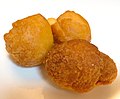 Sata andagi
 -
 Making sata andagi
 -
 Sata andagi


Medical Disclaimer: WikiMD is for informational purposes only and is not a substitute for professional medical advice. Content may be inaccurate or outdated and should not be used for diagnosis or treatment. Always consult your healthcare provider for medical decisions. Verify information with trusted sources such as CDC.gov and NIH.gov. By using this site, you agree that WikiMD is not liable for any outcomes related to its content. See full disclaimer.
Credits:Most images are courtesy of Wikimedia commons, and templates, categories Wikipedia, licensed under CC BY SA or similar.
Translate page: - East Asian
中文,
日本,
한국어,
South Asian
हिन्दी,
தமிழ்,
తెలుగు,
Urdu,
ಕನ್ನಡ,
Southeast Asian
Indonesian,
Vietnamese,
Thai,
မြန်မာဘာသာ,
বাংলা
European
español,
Deutsch,
français,
Greek,
português do Brasil,
polski,
română,
русский,
Nederlands,
norsk,
svenska,
suomi,
Italian
Middle Eastern & African
عربى,
Turkish,
Persian,
Hebrew,
Afrikaans,
isiZulu,
Kiswahili,
Other
Bulgarian,
Hungarian,
Czech,
Swedish,
മലയാളം,
मराठी,
ਪੰਜਾਬੀ,
ગુજરાતી,
Portuguese,
Ukrainian

