Santalum album
Santalum album, also known as Indian sandalwood or white sandalwood, is a small tropical tree species that belongs to the Santalaceae family. It is native to southern India and Southeast Asia, but is now cultivated in various regions worldwide due to its high economic value.
Description[edit]
Santalum album is a small evergreen tree that can grow up to 9 meters in height. The tree has a slender trunk, drooping branches, and leathery leaves. The bark is smooth and gray, while the wood is heavy, yellow, and fine-grained. The tree produces small, purple-brown flowers and small, black fruit.
Cultivation and Uses[edit]
Santalum album is primarily cultivated for its wood and oil, which are highly valued in many cultures. The wood is used for carving and to make furniture and musical instruments, while the oil is used in perfumes, cosmetics, and traditional medicines. The tree is also used in religious rituals and ceremonies in many cultures.
Conservation Status[edit]
Due to over-harvesting and habitat loss, Santalum album is listed as vulnerable by the International Union for Conservation of Nature (IUCN) Red List. Efforts are being made to conserve the species through sustainable cultivation practices and legal protection.
References[edit]
See Also[edit]
-
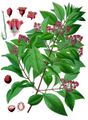 Santalum album - Köhler's Medizinal Pflanzen
 -
Santalum album
-
Santalum album (Chandan) in Hyderabad
-
Santalum album Fruit
-
Santalum album Leaf
-
Santalum album Sapling


Medical Disclaimer: WikiMD is for informational purposes only and is not a substitute for professional medical advice. Content may be inaccurate or outdated and should not be used for diagnosis or treatment. Always consult your healthcare provider for medical decisions. Verify information with trusted sources such as CDC.gov and NIH.gov. By using this site, you agree that WikiMD is not liable for any outcomes related to its content. See full disclaimer.
Credits:Most images are courtesy of Wikimedia commons, and templates, categories Wikipedia, licensed under CC BY SA or similar.
Translate page: - East Asian
中文,
日本,
한국어,
South Asian
हिन्दी,
தமிழ்,
తెలుగు,
Urdu,
ಕನ್ನಡ,
Southeast Asian
Indonesian,
Vietnamese,
Thai,
မြန်မာဘာသာ,
বাংলা
European
español,
Deutsch,
français,
Greek,
português do Brasil,
polski,
română,
русский,
Nederlands,
norsk,
svenska,
suomi,
Italian
Middle Eastern & African
عربى,
Turkish,
Persian,
Hebrew,
Afrikaans,
isiZulu,
Kiswahili,
Other
Bulgarian,
Hungarian,
Czech,
Swedish,
മലയാളം,
मराठी,
ਪੰਜਾਬੀ,
ગુજરાતી,
Portuguese,
Ukrainian


_in_Hyderabad,_AP_W2_IMG_0023.jpg)


