Rodízio
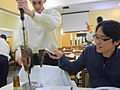
Rodízio is a style of restaurant service in Brazilian restaurants. In most areas of the world outside of Brazil, a rodízio restaurant refers to a Brazilian steakhouse. Rodízio style service is unique in that waiters move around the restaurant with the skewers, slicing meat onto the customer's plate. This serving style is commonly found in many Churrascaria restaurants, particularly in Brazil.
History[edit]
The term rodízio is derived from the Portuguese word "rodar", which means to rotate. The concept originated in the early 19th century in the southern regions of Brazil, where gauchos (Brazilian cowboys) would prepare large pieces of meat and serve them in a rotating manner. This was done to ensure that everyone at the table received a portion of each type of meat.
Service Style[edit]
In a rodízio service, customers pay a fixed price, and the waiters bring samples of food to each customer at several times throughout the meal, until the customers signal that they have had enough. In many restaurants, the customers are provided with a colored card, red on one side and green on the other. The servers will not bring more meat if the card is turned to the red side.
The rodízio style is most popularly known for its service of various cuts of meat, including beef, pork, chicken, and sometimes exotic meats. However, it can also be used to serve a wide variety of foods, including pizza and sushi.
Variations[edit]
There are several variations of rodízio in Brazil, including:
- Rodízio de Pizza: Where various pizzas are served.
- Rodízio de Sushi: Where various sushi dishes are served.
- Rodízio de Churrasco: Where various grilled meats are served.
See Also[edit]
 | This Brazilian cuisine–related article is a stub. You can help WikiMD by expanding the page. |

-
 Rodízio
 -
 Rodízio
 -
 Rodízio
 -
 Rodízio
 -
 Rodízio


.jpg)

.jpg)

Medical Disclaimer: WikiMD is for informational purposes only and is not a substitute for professional medical advice. Content may be inaccurate or outdated and should not be used for diagnosis or treatment. Always consult your healthcare provider for medical decisions. Verify information with trusted sources such as CDC.gov and NIH.gov. By using this site, you agree that WikiMD is not liable for any outcomes related to its content. See full disclaimer.
Credits:Most images are courtesy of Wikimedia commons, and templates, categories Wikipedia, licensed under CC BY SA or similar.
Translate page: - East Asian
中文,
日本,
한국어,
South Asian
हिन्दी,
தமிழ்,
తెలుగు,
Urdu,
ಕನ್ನಡ,
Southeast Asian
Indonesian,
Vietnamese,
Thai,
မြန်မာဘာသာ,
বাংলা
European
español,
Deutsch,
français,
Greek,
português do Brasil,
polski,
română,
русский,
Nederlands,
norsk,
svenska,
suomi,
Italian
Middle Eastern & African
عربى,
Turkish,
Persian,
Hebrew,
Afrikaans,
isiZulu,
Kiswahili,
Other
Bulgarian,
Hungarian,
Czech,
Swedish,
മലയാളം,
मराठी,
ਪੰਜਾਬੀ,
ગુજરાતી,
Portuguese,
Ukrainian

