Rice cake
| Rice cake.jpg | |
| A variety of rice cakes | |
| Alternative names | |
| Type | |
| Course | Snack, Dessert, Staple |
| Place of origin | Various |
| Region or state | |
| Associated national cuisine | |
| Created by | |
| Invented | |
| Cooking time | minutes to minutes |
| Serving temperature | Hot, Cold |
| Main ingredients | Rice |
| Ingredients generally used | |
| Variations | |
| Food energy | kcal |
| Nutritional value | Protein: g, Fat: g, Carbohydrate: g |
| Glycemic index | |
| Similar dishes | |
| Other information | |
| Website | [ Official website] |
Rice cakes are a type of food made from rice that has been shaped and compressed into a single object. They are a versatile food item found in many different cultures around the world, with each culture having its own unique version of a rice cake. Rice cakes can be sweet or savory, and they can be eaten as a snack, dessert, or even as a staple part of a meal.
History[edit]
The history of rice cakes dates back thousands of years, with their origins deeply rooted in Asian cultures. In countries like Japan, Korea, and China, rice cakes have been a significant part of traditional festivities and daily meals. Over time, the popularity of rice cakes spread to other parts of the world, adapting to local tastes and ingredients.
Types[edit]
There are many different types of rice cakes, each with its own preparation method and flavor profile. Some of the most popular include:
- Mochi - A Japanese rice cake made from glutinous rice pounded into paste and molded into shape.
- Tteok - A Korean rice cake that comes in many varieties, often steamed, pounded, or boiled.
- Puto - A Filipino steamed rice cake, traditionally made from slightly fermented rice dough.
- Idli - A type of savory rice cake popular in South India, made by steaming a batter consisting of fermented black lentils and rice.
Preparation[edit]
The preparation of rice cakes varies significantly depending on the type. Generally, it involves cooking rice or a rice-based batter and then shaping it into cakes. Some rice cakes are made from whole rice grains, while others use ground rice or rice flour. The rice or batter can be steamed, boiled, fried, or baked to create different textures and flavors.
Cultural Significance[edit]
Rice cakes hold cultural significance in many countries. For example, in Korea, tteokguk (a soup with sliced rice cakes) is traditionally eaten during the celebration of the Lunar New Year to symbolize gaining a year of age and the hope for a prosperous year. In Japan, mochi is often made and eaten during New Year's celebrations as a symbol of longevity and well-being.
Nutritional Value[edit]
Rice cakes are generally low in calories and fat, making them a popular choice for people looking for a light snack. However, since they are primarily made of rice, they are high in carbohydrates. The nutritional value can vary greatly depending on the type of rice cake and its additional ingredients.
See Also[edit]

Rice_cake[edit]
-
Pink seolgitteok cake
-
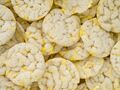 Quaker Popped Rice Snacks
 -
Num Plae Ai
-
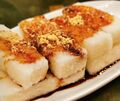 Ciba cake
 -
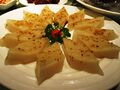 Sweet Tea Olive Cake
 -
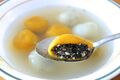 Pumpkin tangyuan with red bean baste and black sesame fillings
 -
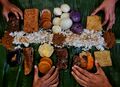 Kakaning Pinoy (The Filipino Rice Cakes)
 -
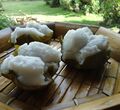 Puto in banana leaf


_with_red_bean_baste_and_black_sesame_fillings.jpg)
.jpg)


Medical Disclaimer: WikiMD is for informational purposes only and is not a substitute for professional medical advice. Content may be inaccurate or outdated and should not be used for diagnosis or treatment. Always consult your healthcare provider for medical decisions. Verify information with trusted sources such as CDC.gov and NIH.gov. By using this site, you agree that WikiMD is not liable for any outcomes related to its content. See full disclaimer.
Credits:Most images are courtesy of Wikimedia commons, and templates, categories Wikipedia, licensed under CC BY SA or similar.
Translate page: - East Asian
中文,
日本,
한국어,
South Asian
हिन्दी,
தமிழ்,
తెలుగు,
Urdu,
ಕನ್ನಡ,
Southeast Asian
Indonesian,
Vietnamese,
Thai,
မြန်မာဘာသာ,
বাংলা
European
español,
Deutsch,
français,
Greek,
português do Brasil,
polski,
română,
русский,
Nederlands,
norsk,
svenska,
suomi,
Italian
Middle Eastern & African
عربى,
Turkish,
Persian,
Hebrew,
Afrikaans,
isiZulu,
Kiswahili,
Other
Bulgarian,
Hungarian,
Czech,
Swedish,
മലയാളം,
मराठी,
ਪੰਜਾਬੀ,
ગુજરાતી,
Portuguese,
Ukrainian


