Reynolds number
Reynolds Number
The Reynolds number (dimensionless quantity) is a fundamental concept in the field of fluid dynamics and heat transfer. It is named after the British scientist Osborne Reynolds (1842–1912), who introduced this concept in the 1880s.
Definition[edit]
The Reynolds number is defined as the ratio of inertial forces to viscous forces and is used to predict the onset of turbulence in fluid flow. It is represented by the formula:
- Re = ρuD/μ
where:
- Re is the Reynolds number,
- ρ is the density of the fluid,
- u is the velocity of the fluid,
- D is the characteristic linear dimension (typically the hydraulic diameter),
- μ is the dynamic viscosity of the fluid.
Applications[edit]
The Reynolds number is used in the analysis and design of fluid flow systems, including the study of aerodynamics, hydrodynamics, and heat transfer. It helps in predicting the transition from laminar to turbulent flow, which is critical in many engineering applications such as pipe flow, heat exchangers, and aerodynamic design.
Reynolds Number and Flow Regimes[edit]
The Reynolds number can be used to predict the behavior of fluid flow:
- Re < 2000: The flow is laminar, characterized by smooth, constant fluid motion.
- 2000 < Re < 4000: The flow is in a transition state, neither fully laminar nor fully turbulent.
- Re > 4000: The flow is turbulent, characterized by chaotic, eddy currents.
See also[edit]
References[edit]
<references />
| Fluid dynamics | ||||||||||
|---|---|---|---|---|---|---|---|---|---|---|
This fluid dynamics related article is a stub.
|
 | This physics-related article is a stub. You can help WikiMD by expanding the page. |
-
 Tap
Tap -
 Clean water for a village in West Lombok
 -
 Laminar-turbulent transition
 -
 Vortex street animation
 -
 G. G. Stokes
 -
 Osborne Reynolds
 -
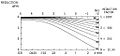 Brezina equation
 -
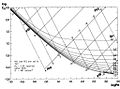 SED equation 1
 -
 SED equation 3
 -
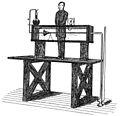 Reynolds fluid turbulence experiment 1883
 -
 Flows from Reynolds 1883 paper
 -
 Honey
Honey

.jpg)


Medical Disclaimer: WikiMD is for informational purposes only and is not a substitute for professional medical advice. Content may be inaccurate or outdated and should not be used for diagnosis or treatment. Always consult your healthcare provider for medical decisions. Verify information with trusted sources such as CDC.gov and NIH.gov. By using this site, you agree that WikiMD is not liable for any outcomes related to its content. See full disclaimer.
Credits:Most images are courtesy of Wikimedia commons, and templates, categories Wikipedia, licensed under CC BY SA or similar.
Translate this page: - East Asian
中文,
日本,
한국어,
South Asian
हिन्दी,
தமிழ்,
తెలుగు,
Urdu,
ಕನ್ನಡ,
Southeast Asian
Indonesian,
Vietnamese,
Thai,
မြန်မာဘာသာ,
বাংলা
European
español,
Deutsch,
français,
Greek,
português do Brasil,
polski,
română,
русский,
Nederlands,
norsk,
svenska,
suomi,
Italian
Middle Eastern & African
عربى,
Turkish,
Persian,
Hebrew,
Afrikaans,
isiZulu,
Kiswahili,
Other
Bulgarian,
Hungarian,
Czech,
Swedish,
മലയാളം,
मराठी,
ਪੰਜਾਬੀ,
ગુજરાતી,
Portuguese,
Ukrainian
