Reflexology
Reflexology, also known as zone therapy, is an alternative medicine involving application of pressure to the feet and hands with specific thumb, finger, and hand techniques. It is based on a pseudoscientific system of zones and reflex areas that purportedly reflect an image of the body on the feet and hands, with the premise that such work on the feet and hands causes a physical change to the related areas of the body.
History[edit]
Reflexology was introduced to the United States in 1913 by William H. Fitzgerald, M.D. (1872–1942), an ear, nose, and throat specialist, and Dr. Edwin Bowers. Fitzgerald claimed that applying pressure had an anesthetic effect on other areas of the body.
Practice[edit]
Practitioners divide the body into ten equal vertical zones, five on the right and five on the left. Concerns have been raised by medical professionals that treating potentially serious illnesses with reflexology, which has no proven efficacy, could delay the seeking of appropriate medical treatment.
Effectiveness[edit]
Reviews from 2009 and 2011 have not found evidence sufficient to support the use of reflexology for any medical condition. A 2009 systematic review of randomized controlled trials concluded: "The best evidence available to date does not demonstrate convincingly that reflexology is an effective treatment for any medical condition."
Safety[edit]
There is no consensus among reflexologists on how reflexology is supposed to work; a unifying theme is the idea that areas on the foot correspond to areas of the body, and that by manipulating these one can improve health through one's qi. Reflexologists divide the body into ten equal vertical zones, five on the right and five on the left. Concerns have been raised by medical professionals that treating potentially serious illnesses with reflexology, which has no proven efficacy, could delay the seeking of appropriate medical treatment.
See also[edit]
References[edit]

This WikiMD article can only be edited by registered and verified editors. You can log in or register.
Reflexology[edit]
-
 Foot Chart 1
 -
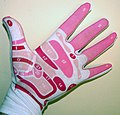 Reflexology of the Hand


Medical Disclaimer: WikiMD is for informational purposes only and is not a substitute for professional medical advice. Content may be inaccurate or outdated and should not be used for diagnosis or treatment. Always consult your healthcare provider for medical decisions. Verify information with trusted sources such as CDC.gov and NIH.gov. By using this site, you agree that WikiMD is not liable for any outcomes related to its content. See full disclaimer.
Credits:Most images are courtesy of Wikimedia commons, and templates, categories Wikipedia, licensed under CC BY SA or similar.
Translate page: - East Asian
中文,
日本,
한국어,
South Asian
हिन्दी,
தமிழ்,
తెలుగు,
Urdu,
ಕನ್ನಡ,
Southeast Asian
Indonesian,
Vietnamese,
Thai,
မြန်မာဘာသာ,
বাংলা
European
español,
Deutsch,
français,
Greek,
português do Brasil,
polski,
română,
русский,
Nederlands,
norsk,
svenska,
suomi,
Italian
Middle Eastern & African
عربى,
Turkish,
Persian,
Hebrew,
Afrikaans,
isiZulu,
Kiswahili,
Other
Bulgarian,
Hungarian,
Czech,
Swedish,
മലയാളം,
मराठी,
ਪੰਜਾਬੀ,
ગુજરાતી,
Portuguese,
Ukrainian

