Recapitulation theory
Recapitulation theory, often encapsulated in the phrase "ontogeny recapitulates phylogeny," is a historical scientific theory that suggests an individual organism's developmental process (ontogeny) mirrors the evolutionary history of its species (phylogeny). This concept, first proposed by German naturalist Ernst Haeckel in the late 19th century, posits that the stages an embryo undergoes during development are a sequential replay of its species' evolutionary past. While the theory has been largely discredited in its original form, it has played a significant role in the development of evolutionary biology and our understanding of genetics and embryology.
History[edit]
The roots of recapitulation theory can be traced back to the work of pre-Darwinian naturalists, but it was Ernst Haeckel who fully articulated the theory in the context of Darwin's theory of evolution. Haeckel's formulation was summarized in his law of biogenetics, which comprises two main ideas: the biogenetic law and the theory of terminal addition. The biogenetic law states that the development of an individual recapitulates the evolutionary development of its species. The theory of terminal addition posited that new stages of development were added at the end of an individual's ontogeny to represent the most recent evolutionary changes.
Criticism and Reevaluation[edit]
Recapitulation theory faced significant criticism even during Haeckel's time. Critics pointed out numerous exceptions to the theory and highlighted that embryonic stages could not be directly equated with adult ancestral forms. In the 20th century, with advances in genetics and a better understanding of evolutionary mechanisms, the theory was further discredited. Modern evolutionary developmental biology, or evo-devo, has shown that while there are connections between development and evolution, they are far more complex than Haeckel's theory suggested. Instead of a simple linear progression, development and evolution involve a web of genetic and environmental interactions.
Modern Perspectives[edit]
Today, recapitulation theory is considered an oversimplification of the complex processes that shape development and evolution. However, the idea that ontogeny and phylogeny are related has not been entirely abandoned. Current research in evo-devo has uncovered instances where developmental processes reflect evolutionary history, albeit in a more nuanced and complex manner than Haeckel proposed. For example, the presence of gill slit-like structures in human embryos reflects our distant common ancestry with fish, though not in the direct manner Haeckel suggested.
Conclusion[edit]
While recapitulation theory as originally proposed by Haeckel is no longer accepted, its historical significance and the discussions it spurred have contributed to the advancement of biological sciences. It serves as a reminder of the evolving nature of scientific theories and the importance of evidence-based revisions in the pursuit of understanding the natural world.

-
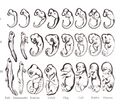 Haeckel drawings
 -
Wilhelm His chick brain compared to folded rubber tube
-
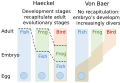 Haeckel vs von Baer


Medical Disclaimer: WikiMD is for informational purposes only and is not a substitute for professional medical advice. Content may be inaccurate or outdated and should not be used for diagnosis or treatment. Always consult your healthcare provider for medical decisions. Verify information with trusted sources such as CDC.gov and NIH.gov. By using this site, you agree that WikiMD is not liable for any outcomes related to its content. See full disclaimer.
Credits:Most images are courtesy of Wikimedia commons, and templates, categories Wikipedia, licensed under CC BY SA or similar.
Translate page: - East Asian
中文,
日本,
한국어,
South Asian
हिन्दी,
தமிழ்,
తెలుగు,
Urdu,
ಕನ್ನಡ,
Southeast Asian
Indonesian,
Vietnamese,
Thai,
မြန်မာဘာသာ,
বাংলা
European
español,
Deutsch,
français,
Greek,
português do Brasil,
polski,
română,
русский,
Nederlands,
norsk,
svenska,
suomi,
Italian
Middle Eastern & African
عربى,
Turkish,
Persian,
Hebrew,
Afrikaans,
isiZulu,
Kiswahili,
Other
Bulgarian,
Hungarian,
Czech,
Swedish,
മലയാളം,
मराठी,
ਪੰਜਾਬੀ,
ગુજરાતી,
Portuguese,
Ukrainian


