Rat-tailed maggot
The Rat-tailed Maggot is the larval stage of certain species of hoverflies. A characteristic feature of these larvae is a tube-like, telescoping breathing siphon located at its posterior end, giving them their common name. This siphon often gives an appearance of a tail, hence the name "rat-tailed."
Biology[edit]
Rat-tailed maggots are typically found in stagnant water, such as sewage and lagoons. They are also found in manure and compost heaps. The larvae are well adapted to survive in these low-oxygen environments due to their siphon, which they use like a snorkel.
Species[edit]
The most common species of rat-tailed maggots are from the Eristalis genus, including Eristalis tenax, the drone fly. Other species include Eristalis arbustorum and Eristalis cryptarum.
Life Cycle[edit]
The life cycle of a rat-tailed maggot consists of four stages: egg, larva, pupa, and adult. The female hoverfly lays her eggs in stagnant water or manure. The eggs hatch into larvae, which grow and eventually pupate. The adult hoverfly emerges from the pupa.
Medical Significance[edit]
While rat-tailed maggots are not directly harmful to humans, they are often associated with dirty environments and can indicate a lack of sanitation. In rare cases, they can cause myiasis, a parasitic infection.
See Also[edit]

This WikiMD article can only be edited by registered and verified editors. You can log in or register.
-
 Eristalis tenax larva close-up
 -
 Eristalis tenax on cup
 -
 Rat-tailed maggot
 -
 Australian Rat-tailed fly larva
 -
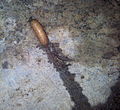 Rat-tailed maggot leaving water to pupate


.jpg)

Medical Disclaimer: WikiMD is for informational purposes only and is not a substitute for professional medical advice. Content may be inaccurate or outdated and should not be used for diagnosis or treatment. Always consult your healthcare provider for medical decisions. Verify information with trusted sources such as CDC.gov and NIH.gov. By using this site, you agree that WikiMD is not liable for any outcomes related to its content. See full disclaimer.
Credits:Most images are courtesy of Wikimedia commons, and templates, categories Wikipedia, licensed under CC BY SA or similar.
Translate page: - East Asian
中文,
日本,
한국어,
South Asian
हिन्दी,
தமிழ்,
తెలుగు,
Urdu,
ಕನ್ನಡ,
Southeast Asian
Indonesian,
Vietnamese,
Thai,
မြန်မာဘာသာ,
বাংলা
European
español,
Deutsch,
français,
Greek,
português do Brasil,
polski,
română,
русский,
Nederlands,
norsk,
svenska,
suomi,
Italian
Middle Eastern & African
عربى,
Turkish,
Persian,
Hebrew,
Afrikaans,
isiZulu,
Kiswahili,
Other
Bulgarian,
Hungarian,
Czech,
Swedish,
മലയാളം,
मराठी,
ਪੰਜਾਬੀ,
ગુજરાતી,
Portuguese,
Ukrainian

