Radical perineal prostatectomy
Radical Perineal Prostatectomy is a surgical procedure used to treat prostate cancer. It involves the removal of the entire prostate gland and some surrounding tissue. This procedure is less commonly used than the radical retropubic prostatectomy, but it may be an option for certain patients.
Procedure[edit]
The patient is placed under general or spinal anesthesia. The surgeon makes an incision in the perineum, the area between the scrotum and the anus. The prostate gland is then removed through this incision. The surgeon may also remove the seminal vesicles and nearby lymph nodes.
Advantages and Disadvantages[edit]
The main advantage of a radical perineal prostatectomy is that it causes less blood loss than other types of prostatectomy. It also has a shorter recovery time. However, it may not be suitable for all patients. For example, it may not be possible to perform this procedure on men with large prostates or those who are obese. In addition, this procedure may not be as effective at controlling cancer as other types of prostatectomy.
Risks and Complications[edit]
As with any surgical procedure, there are risks associated with a radical perineal prostatectomy. These include infection, bleeding, and damage to nearby organs. There is also a risk of sexual dysfunction and urinary incontinity.
Recovery[edit]
Recovery from a radical perineal prostatectomy typically takes a few weeks. Patients may need to use a catheter to drain urine for a short time after the surgery. They may also need to take medications to manage pain and prevent infection.
See Also[edit]

This WikiMD article can only be edited by registered and verified editors. You can log in or register.
-
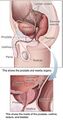 Radical perineal prostatectomy
 -
 Diagram showing before and after a radical prostatectomy


Medical Disclaimer: WikiMD is for informational purposes only and is not a substitute for professional medical advice. Content may be inaccurate or outdated and should not be used for diagnosis or treatment. Always consult your healthcare provider for medical decisions. Verify information with trusted sources such as CDC.gov and NIH.gov. By using this site, you agree that WikiMD is not liable for any outcomes related to its content. See full disclaimer.
Credits:Most images are courtesy of Wikimedia commons, and templates, categories Wikipedia, licensed under CC BY SA or similar.
Translate page: - East Asian
中文,
日本,
한국어,
South Asian
हिन्दी,
தமிழ்,
తెలుగు,
Urdu,
ಕನ್ನಡ,
Southeast Asian
Indonesian,
Vietnamese,
Thai,
မြန်မာဘာသာ,
বাংলা
European
español,
Deutsch,
français,
Greek,
português do Brasil,
polski,
română,
русский,
Nederlands,
norsk,
svenska,
suomi,
Italian
Middle Eastern & African
عربى,
Turkish,
Persian,
Hebrew,
Afrikaans,
isiZulu,
Kiswahili,
Other
Bulgarian,
Hungarian,
Czech,
Swedish,
മലയാളം,
मराठी,
ਪੰਜਾਬੀ,
ગુજરાતી,
Portuguese,
Ukrainian

