RNA virus
RNA virus is a type of virus that has RNA (ribonucleic acid) as its genetic material. This includes viruses that are part of the Retroviridae, Flaviviridae, and Picornaviridae families, among others. The RNA genome can be either single-stranded (ssRNA) or double-stranded (dsRNA), and may contain one or more separate RNA molecules.
Classification[edit]
RNA viruses can be classified into different types based on their genome structure and replication method. These include:
- Positive-sense single-stranded RNA viruses (+ssRNA viruses): These viruses have genetic material that can be directly translated into protein. Examples include West Nile virus, Zika virus, and Hepatitis C virus.
- Negative-sense single-stranded RNA viruses (-ssRNA viruses): These viruses need to be converted into positive-sense RNA by an RNA-dependent RNA polymerase before they can be translated. Examples include Ebola virus, Rabies virus, and Influenza virus.
- Double-stranded RNA viruses (dsRNA viruses): These viruses have a double-stranded RNA genome. Examples include Rotavirus and Bluetongue virus.
- Retroviruses: These viruses have a single-stranded RNA genome that is reverse transcribed into DNA, which is then integrated into the host's genome. Examples include HIV and Human T-lymphotropic virus.
Replication[edit]
RNA viruses replicate through a process called RNA replication, which involves the synthesis of a complementary RNA strand from a template RNA strand. This process is carried out by an enzyme called RNA-dependent RNA polymerase (RdRp), which is encoded by the virus. In the case of retroviruses, the RNA genome is reverse transcribed into DNA by the enzyme reverse transcriptase.
Diseases[edit]
RNA viruses are responsible for a wide range of diseases in humans, animals, and plants. These include AIDS, hepatitis C, Ebola virus disease, Zika fever, influenza, and COVID-19, which is caused by the SARS-CoV-2 virus.
See also[edit]

This WikiMD article can only be edited by registered and verified editors. You can log in or register.
RNA_virus[edit]
-
 18 2014 1695 Fig1 HTML
 -
 Structure of the reovirus virion
 -
 Lassa virus
 -
 Lymphocytic choriomeningitis virus
 -
 Sin Nombre virus Hanta TEM 1137 lores
 -
 Marburg virus
 -
 Ebola virions
 -
 Influenza virus particle 8430 lores
 -
 Measles virus
 -
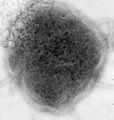 Mumps virus, negative stained TEM 8758 lores
 -
 Respiratory Syncytial Virus (RSV) EM PHIL 2175 lores
 -
 Parainfluenza virus TEM PHIL 271


_EM_PHIL_2175_lores.jpg)


Medical Disclaimer: WikiMD is for informational purposes only and is not a substitute for professional medical advice. Content may be inaccurate or outdated and should not be used for diagnosis or treatment. Always consult your healthcare provider for medical decisions. Verify information with trusted sources such as CDC.gov and NIH.gov. By using this site, you agree that WikiMD is not liable for any outcomes related to its content. See full disclaimer.
Credits:Most images are courtesy of Wikimedia commons, and templates, categories Wikipedia, licensed under CC BY SA or similar.
Translate page: - East Asian
中文,
日本,
한국어,
South Asian
हिन्दी,
தமிழ்,
తెలుగు,
Urdu,
ಕನ್ನಡ,
Southeast Asian
Indonesian,
Vietnamese,
Thai,
မြန်မာဘာသာ,
বাংলা
European
español,
Deutsch,
français,
Greek,
português do Brasil,
polski,
română,
русский,
Nederlands,
norsk,
svenska,
suomi,
Italian
Middle Eastern & African
عربى,
Turkish,
Persian,
Hebrew,
Afrikaans,
isiZulu,
Kiswahili,
Other
Bulgarian,
Hungarian,
Czech,
Swedish,
മലയാളം,
मराठी,
ਪੰਜਾਬੀ,
ગુજરાતી,
Portuguese,
Ukrainian

