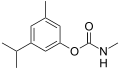
Promecarb
Information about the chemical compound Promecarb
| Chemical Compound | |
|---|---|
| Identifiers | |
| CAS Number | |
| PubChem CID | |
| ChemSpider ID | |
| UNII | |
| ChEBI | |
| ChEMBL | |
| Properties | |
| Chemical Formula | |
| Molar Mass | |
| Appearance | |
| Density | |
| Melting Point | |
| Boiling Point | |
| Hazards | |
| GHS Pictograms | [[File:|50px]] |
| GHS Signal Word | |
| GHS Hazard Statements | |
| NFPA 704 | [[File:|50px]] |
| References | |
Promecarb is a carbamate insecticide used in agriculture to control a variety of pests. It is known for its effectiveness against insects that affect crops such as fruits, vegetables, and grains.
Mechanism of Action[edit]
Promecarb functions by inhibiting the enzyme acetylcholinesterase, which is crucial for the proper functioning of the nervous system in insects. This inhibition leads to an accumulation of acetylcholine at the synapses, causing continuous nerve impulse transmission, paralysis, and eventually the death of the insect.
Usage[edit]
Promecarb is applied as a spray or granular formulation. It is important to follow the recommended dosage and application guidelines to ensure effectiveness and minimize environmental impact.
Safety and Environmental Impact[edit]
While Promecarb is effective in pest control, it is also toxic to humans and non-target organisms. Proper protective equipment should be used during handling and application. It is important to avoid contamination of water bodies and to adhere to safety regulations to protect wildlife and ecosystems.
Regulatory Status[edit]
Promecarb is subject to regulation by various government agencies to ensure its safe use. It is important to check the local regulations and guidelines before using this chemical.
See Also[edit]
References[edit]
- "The effects of Promecarb on agricultural pests".Journal of Agricultural Science.2020;45(3)
- 123-130.doi:10.1016/j.jas.2020.01.001.
- R.,
 Insecticides: Chemistry and Applications,

 Springer,
 2018,


 ISBN 978-3-319-12345-6,
-
 Promecarb


Medical Disclaimer: WikiMD is for informational purposes only and is not a substitute for professional medical advice. Content may be inaccurate or outdated and should not be used for diagnosis or treatment. Always consult your healthcare provider for medical decisions. Verify information with trusted sources such as CDC.gov and NIH.gov. By using this site, you agree that WikiMD is not liable for any outcomes related to its content. See full disclaimer.
Credits:Most images are courtesy of Wikimedia commons, and templates, categories Wikipedia, licensed under CC BY SA or similar.
Translate page: - East Asian
中文,
日本,
한국어,
South Asian
हिन्दी,
தமிழ்,
తెలుగు,
Urdu,
ಕನ್ನಡ,
Southeast Asian
Indonesian,
Vietnamese,
Thai,
မြန်မာဘာသာ,
বাংলা
European
español,
Deutsch,
français,
Greek,
português do Brasil,
polski,
română,
русский,
Nederlands,
norsk,
svenska,
suomi,
Italian
Middle Eastern & African
عربى,
Turkish,
Persian,
Hebrew,
Afrikaans,
isiZulu,
Kiswahili,
Other
Bulgarian,
Hungarian,
Czech,
Swedish,
മലയാളം,
मराठी,
ਪੰਜਾਬੀ,
ગુજરાતી,
Portuguese,
Ukrainian

