Frontal lobe
Frontal lobe is the largest of the four major lobes of the brain in mammals, and is located at the front of each hemisphere. It is separated from the parietal lobe by a groove between tissues, the central sulcus, and from the temporal lobe by a deeper groove, the lateral sulcus.
Anatomy[edit]
The frontal lobe is the same general structure among mammals, but is significantly larger in humans than in other mammals. It is divided into two main areas – the precentral cortex, which is responsible for motor control, and the prefrontal cortex, which is responsible for executive functions such as self-control, planning, reasoning, and abstract thought.
Functions[edit]
The frontal lobe is involved in many functions of the brain, including:
- Motor skills: The frontal lobe includes the primary motor cortex, which is responsible for voluntary movement.
- Language: The frontal lobe is important for expressive language. Broca's area, located in the left frontal lobe, is involved in speech production.
- Executive functions: The frontal lobe is essential for tasks that require planning and decision making. It is also involved in personality and emotion through its connections with the limbic system.
Clinical significance[edit]
Damage to the frontal lobe can lead to a variety of disorders, including:
- Frontal lobe disorder: This is a condition where there is damage to the frontal lobes of the brain that can cause a variety of symptoms, including changes in personality, mood, and behavior.
- Phineas Gage: A famous case of frontal lobe damage. Gage survived an accident in which a large iron rod was driven completely through his head, but his personality changed dramatically.
- Frontotemporal dementia: This is a group of disorders characterized by the progressive atrophy of the frontal and temporal lobes of the brain.
See also[edit]
References[edit]
<references />
 | This medical article is a stub. You can help WikiMD by expanding the page. |
Frontal Lobe[edit]
-
 Diagram of the human brain showing the frontal lobe
 -
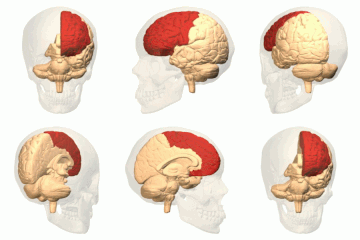 Animation showing the location of the frontal lobe in the brain


Medical Disclaimer: WikiMD is for informational purposes only and is not a substitute for professional medical advice. Content may be inaccurate or outdated and should not be used for diagnosis or treatment. Always consult your healthcare provider for medical decisions. Verify information with trusted sources such as CDC.gov and NIH.gov. By using this site, you agree that WikiMD is not liable for any outcomes related to its content. See full disclaimer.
Credits:Most images are courtesy of Wikimedia commons, and templates, categories Wikipedia, licensed under CC BY SA or similar.
Translate this page: - East Asian
中文,
日本,
한국어,
South Asian
हिन्दी,
தமிழ்,
తెలుగు,
Urdu,
ಕನ್ನಡ,
Southeast Asian
Indonesian,
Vietnamese,
Thai,
မြန်မာဘာသာ,
বাংলা
European
español,
Deutsch,
français,
Greek,
português do Brasil,
polski,
română,
русский,
Nederlands,
norsk,
svenska,
suomi,
Italian
Middle Eastern & African
عربى,
Turkish,
Persian,
Hebrew,
Afrikaans,
isiZulu,
Kiswahili,
Other
Bulgarian,
Hungarian,
Czech,
Swedish,
മലയാളം,
मराठी,
ਪੰਜਾਬੀ,
ગુજરાતી,
Portuguese,
Ukrainian
