Positive feedback
Positive feedback is a process that occurs in a feedback system where the effects of a small disturbance on a system include an increase in the magnitude of the perturbation. That is, A produces more of B which in turn produces more of A. In contrast, a system in which the results of a change act to reduce or counteract it has negative feedback. Both concepts play an important role in science and engineering, including biology, chemistry, and cybernetics.
Mechanisms[edit]
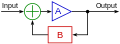
Positive feedback enhances or amplifies an effect by it having an influence on the process which gave rise to it. For example, when part of an electronic output signal is returned to the input, and is in phase with it, the system gain is increased. The feedback from the output to the input can be either direct, or be fed back via another route.
Examples[edit]
Positive feedback is used in digital electronics to force voltages away from intermediate voltages into '0' and '1' states. On the other hand, thermal runaway is a type of positive feedback. The more heat there is, the more heat is generated, and the more heat there is, the more heat is generated.
In biological systems[edit]
Positive feedback is often a normal way of producing rapid change. For example, in neurons, positive feedback plays a critical role in the release of neurotransmitter vesicles, which must occur rapidly in order to propagate nerve impulses.
See also[edit]
 | |
|---|---|
 |
 |
| This medical article is a stub. You can help Wikipedia by adding missing information. |
-
 Positive feedback
 -
 Positive feedback
 -
 Positive feedback
 -
 Positive feedback
 -
 Positive feedback
 -
 Positive feedback
 -
 Positive feedback
 -
 Positive feedback
 -
 Positive feedback
 -
 Positive feedback
 -
 Positive feedback
 -
 Positive feedback


.svg)


Ad. Transform your health with W8MD Weight Loss, Sleep & MedSpa

Tired of being overweight?
Special offer:
Budget GLP-1 weight loss medications
- Semaglutide starting from $29.99/week and up with insurance for visit of $59.99 and up per week self pay.
- Tirzepatide starting from $45.00/week and up (dose dependent) or $69.99/week and up self pay
✔ Same-week appointments, evenings & weekends ✔ Tele visits available with certain limitations Learn more:
- GLP-1 weight loss clinic NYC
- W8MD's NYC medical weight loss
- W8MD Philadelphia GLP-1 shots
- Philadelphia GLP-1 injections
- Affordable GLP-1 shots NYC
- Budget GLP-1 shots
|
WikiMD Medical Encyclopedia |
Medical Disclaimer: WikiMD is for informational purposes only and is not a substitute for professional medical advice. Content may be inaccurate or outdated and should not be used for diagnosis or treatment. Always consult your healthcare provider for medical decisions. Verify information with trusted sources such as CDC.gov and NIH.gov. By using this site, you agree that WikiMD is not liable for any outcomes related to its content. See full disclaimer.
Credits:Most images are courtesy of Wikimedia commons, and templates, categories Wikipedia, licensed under CC BY SA or similar.
Translate this page: - East Asian
中文,
日本,
한국어,
South Asian
हिन्दी,
தமிழ்,
తెలుగు,
Urdu,
ಕನ್ನಡ,
Southeast Asian
Indonesian,
Vietnamese,
Thai,
မြန်မာဘာသာ,
বাংলা
European
español,
Deutsch,
français,
Greek,
português do Brasil,
polski,
română,
русский,
Nederlands,
norsk,
svenska,
suomi,
Italian
Middle Eastern & African
عربى,
Turkish,
Persian,
Hebrew,
Afrikaans,
isiZulu,
Kiswahili,
Other
Bulgarian,
Hungarian,
Czech,
Swedish,
മലയാളം,
मराठी,
ਪੰਜਾਬੀ,
ગુજરાતી,
Portuguese,
Ukrainian
