Population inversion
Population inversion
[[File:[[File:|frameless]]|frameless|alt=]]
| Field | |
|---|---|
| Symbol(s) | |
| SI unit | |
| Derived from | |
| Dimension | |
| In SI base units | |
| Named after | [[]] |
| Discovered by | [[]] |
| Discovery year | |
| Common symbols |
Population inversion is a phenomenon that occurs in certain physical systems, particularly in the field of quantum mechanics. It refers to the situation where the number of particles in an excited state is greater than the number of particles in the ground state. This inversion of population is a crucial requirement for the operation of various devices such as lasers and masers.
Overview[edit]
In a typical physical system, particles tend to occupy the lowest energy state available to them, known as the ground state. However, under certain conditions, such as the application of external energy or the interaction with other particles, some particles can be excited to higher energy states. When the number of particles in the excited state exceeds the number in the ground state, a population inversion occurs.
Population inversion is a non-equilibrium state and is often achieved by pumping energy into the system. This can be done through various methods, such as optical pumping, electrical discharge, or chemical reactions. The energy input raises the energy levels of the particles, causing more of them to occupy the excited states.
Applications[edit]
Population inversion is a fundamental requirement for the operation of lasers and masers. In a laser, the population inversion allows for the amplification of light through stimulated emission. When a photon interacts with an excited particle, it triggers the emission of another photon with the same energy, phase, and direction. This process leads to the amplification of light, resulting in a coherent and intense beam.
The concept of population inversion is also important in the field of atomic physics. It plays a crucial role in the operation of atomic clocks, where the population inversion of certain atomic energy levels is used to measure time with high precision.
Challenges[edit]
Achieving and maintaining population inversion can be challenging due to various factors. One of the main challenges is the relaxation processes that tend to bring the excited particles back to the ground state. These processes include spontaneous emission, collisional de-excitation, and non-radiative decay. To overcome these challenges, careful engineering of the system and the use of appropriate materials and techniques are required.
See also[edit]
References[edit]
-
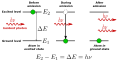 Stimulated emission process
 -
 Three-level population inversion
 -
 Four-level population inversion


Medical Disclaimer: WikiMD is for informational purposes only and is not a substitute for professional medical advice. Content may be inaccurate or outdated and should not be used for diagnosis or treatment. Always consult your healthcare provider for medical decisions. Verify information with trusted sources such as CDC.gov and NIH.gov. By using this site, you agree that WikiMD is not liable for any outcomes related to its content. See full disclaimer.
Credits:Most images are courtesy of Wikimedia commons, and templates, categories Wikipedia, licensed under CC BY SA or similar.
Translate page: - East Asian
中文,
日本,
한국어,
South Asian
हिन्दी,
தமிழ்,
తెలుగు,
Urdu,
ಕನ್ನಡ,
Southeast Asian
Indonesian,
Vietnamese,
Thai,
မြန်မာဘာသာ,
বাংলা
European
español,
Deutsch,
français,
Greek,
português do Brasil,
polski,
română,
русский,
Nederlands,
norsk,
svenska,
suomi,
Italian
Middle Eastern & African
عربى,
Turkish,
Persian,
Hebrew,
Afrikaans,
isiZulu,
Kiswahili,
Other
Bulgarian,
Hungarian,
Czech,
Swedish,
മലയാളം,
मराठी,
ਪੰਜਾਬੀ,
ગુજરાતી,
Portuguese,
Ukrainian

