Poison ivy
Poison Ivy (Toxicodendron radicans) is a poisonous North American plant that is well-known for causing an itchy, irritating, and sometimes painful rash in most people who touch it, due to urushiol, a clear liquid compound in the plant's sap. The plant is a member of the family Anacardiaceae.
Description[edit]
Poison ivy can be found growing in any of the following three forms:
- as a trailing vine that is 10–25 cm tall,
- as a shrub up to 1.2 m tall,
- as a climbing vine that grows on trees or some other support.
Distribution and habitat[edit]
Poison ivy grows throughout much of North America, including the Canadian Maritime provinces, Quebec, Ontario, Manitoba, and all U.S. states east of the Rockies, as well as in the mountainous areas of Mexico up to around 1,500 m (4,900 ft) (caquistle or caxuistle is the Nahuatl term ), and is normally found in wooded areas, especially along edge areas.
Toxicity[edit]
Urushiol-induced contact dermatitis is the allergic reaction caused by poison ivy. In extreme cases, a reaction can progress to anaphylaxis. Around 15% to 30% of people have no allergic reaction to urushiol, but most people will have a greater reaction with repeated or more concentrated exposure.
Treatment[edit]
The rash caused by poison ivy can be treated with calamine lotion or other over-the-counter treatments. In severe cases, a healthcare provider may prescribe corticosteroids.
See also[edit]
References[edit]
External links[edit]

This WikiMD article can only be edited by registered and verified editors. You can log in or register.
Poison_ivy[edit]
-
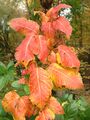 Poison Ivy foliage during autumn leaf coloration in Ewing, New Jersey
 -
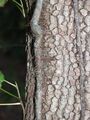 Poison ivy vine
 -
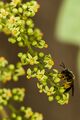 Toxicodendron radicans
 -
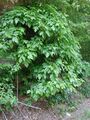 Poison ivy roadside
 -
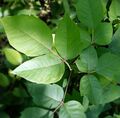 Poison ivy in May beside Appalachian Trail in Rockfish Gap VA area
 -
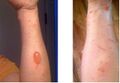 Urushiol induced contact dermatitis


Medical Disclaimer: WikiMD is for informational purposes only and is not a substitute for professional medical advice. Content may be inaccurate or outdated and should not be used for diagnosis or treatment. Always consult your healthcare provider for medical decisions. Verify information with trusted sources such as CDC.gov and NIH.gov. By using this site, you agree that WikiMD is not liable for any outcomes related to its content. See full disclaimer.
Credits:Most images are courtesy of Wikimedia commons, and templates, categories Wikipedia, licensed under CC BY SA or similar.
Translate page: - East Asian
中文,
日本,
한국어,
South Asian
हिन्दी,
தமிழ்,
తెలుగు,
Urdu,
ಕನ್ನಡ,
Southeast Asian
Indonesian,
Vietnamese,
Thai,
မြန်မာဘာသာ,
বাংলা
European
español,
Deutsch,
français,
Greek,
português do Brasil,
polski,
română,
русский,
Nederlands,
norsk,
svenska,
suomi,
Italian
Middle Eastern & African
عربى,
Turkish,
Persian,
Hebrew,
Afrikaans,
isiZulu,
Kiswahili,
Other
Bulgarian,
Hungarian,
Czech,
Swedish,
മലയാളം,
मराठी,
ਪੰਜਾਬੀ,
ગુજરાતી,
Portuguese,
Ukrainian

