Po' boy
Introduction[edit]
A Po' boy is a traditional sandwich from Louisiana, United States. It typically consists of meat, usually roast beef or fried seafood, served on baguette-like New Orleans French bread.
History[edit]
The Po' boy sandwich originated in Louisiana in the late 1920s. It was created by Benny and Clovis Martin, former streetcar conductors who opened a restaurant in the French Market of New Orleans. During a four-month strike against the streetcar company, the Martin brothers served their former colleagues free sandwiches. The Martins referred to the strikers as "poor boys", and soon the sandwiches themselves took on the name.
Ingredients and Variations[edit]
A traditional Po' boy is filled with roast beef or fried seafood, including shrimp, crawfish, oysters, or crab. The meat is served on baguette-like New Orleans French bread, known for its crisp crust and fluffy center. The sandwich is typically dressed with lettuce, tomatoes, pickles, and mayonnaise.
There are many variations of the Po' boy. Some versions include the "Peacemaker", which includes fried oysters and shrimp, and the "Muffuletta Po' Boy", which includes Italian meats and cheeses.
Cultural Significance[edit]
The Po' boy is an iconic symbol of Louisiana's rich cultural and culinary history. It is a staple at many New Orleans events, including the annual New Orleans Po' Boy Preservation Festival. The sandwich is also a common feature on the menus of restaurants throughout the city and the state.
See Also[edit]
References[edit]
- The Southern Po' Boy Cookbook: Mouthwatering Sandwich Recipes from the Heart of New Orleans. Todd-Michael St. Pierre. Ulysses Press, 2013.
- New Orleans: A Food Biography. Elizabeth M. Williams. Rowman & Littlefield, 2012.
External Links[edit]
Po' boy[edit]
-
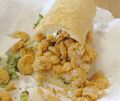 Shrimp po' boy
 -
Hot roast beef with gravy po' boy, dressed
-
Shrimp po' boy from Middendorf's


Medical Disclaimer: WikiMD is for informational purposes only and is not a substitute for professional medical advice. Content may be inaccurate or outdated and should not be used for diagnosis or treatment. Always consult your healthcare provider for medical decisions. Verify information with trusted sources such as CDC.gov and NIH.gov. By using this site, you agree that WikiMD is not liable for any outcomes related to its content. See full disclaimer.
Credits:Most images are courtesy of Wikimedia commons, and templates, categories Wikipedia, licensed under CC BY SA or similar.
Translate page: - East Asian
中文,
日本,
한국어,
South Asian
हिन्दी,
தமிழ்,
తెలుగు,
Urdu,
ಕನ್ನಡ,
Southeast Asian
Indonesian,
Vietnamese,
Thai,
မြန်မာဘာသာ,
বাংলা
European
español,
Deutsch,
français,
Greek,
português do Brasil,
polski,
română,
русский,
Nederlands,
norsk,
svenska,
suomi,
Italian
Middle Eastern & African
عربى,
Turkish,
Persian,
Hebrew,
Afrikaans,
isiZulu,
Kiswahili,
Other
Bulgarian,
Hungarian,
Czech,
Swedish,
മലയാളം,
मराठी,
ਪੰਜਾਬੀ,
ગુજરાતી,
Portuguese,
Ukrainian


