Pig roast
Pig roast is a cooking method that involves the barbecuing of a whole pig. This method of cooking is popular in various cultures around the world and is often associated with celebratory events and gatherings.
History[edit]
The history of pig roasting dates back to ancient times. It was a common practice in many cultures, including the Ancient Greeks, Romans, and Pacific Islanders. The method was often used for large gatherings and celebrations, as it allowed for the preparation of a substantial amount of food at once.
Preparation[edit]
The preparation of a pig roast involves several steps. First, the pig is slaughtered and cleaned. The pig is then marinated or seasoned, depending on the specific recipe being used. The pig is then placed on a large spit, which is a long, solid rod used to hold food while it is being cooked over a fire. The spit is turned slowly to ensure that the pig is cooked evenly.
Cultural Significance[edit]
Pig roasts hold significant cultural importance in many societies. In Hawaii, for example, a pig roast, known as a luau, is a traditional part of many celebrations. Similarly, in the Philippines, a pig roast, or lechon, is often the centerpiece of special occasions. In Spain, a pig roast, or cochinillo asado, is a traditional dish served during festive periods.
Variations[edit]
There are several variations of pig roast around the world. These variations often involve different methods of preparation, cooking, and serving. For example, in Cuba, the pig is marinated in a mixture of garlic, oregano, and sour orange before being roasted. In Germany, the pig is often stuffed with a mixture of bread, onions, and various herbs before being roasted.
See Also[edit]

-
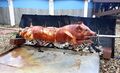 Pig roasting on a spit
 -
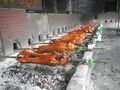 Paang Bundok, La Loma, Quezon City
 -
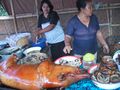 Babi Guling - Roast suckling pig
 -
 Traditional Filipino cuisine
 -
 Het braden van varkens op de Filippijnen
 -
 Lechon
 -
 Roasted pig served at a summer wedding in the US
 -
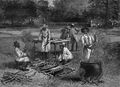 A Southern Barbecue


Medical Disclaimer: WikiMD is for informational purposes only and is not a substitute for professional medical advice. Content may be inaccurate or outdated and should not be used for diagnosis or treatment. Always consult your healthcare provider for medical decisions. Verify information with trusted sources such as CDC.gov and NIH.gov. By using this site, you agree that WikiMD is not liable for any outcomes related to its content. See full disclaimer.
Credits:Most images are courtesy of Wikimedia commons, and templates, categories Wikipedia, licensed under CC BY SA or similar.
Translate page: - East Asian
中文,
日本,
한국어,
South Asian
हिन्दी,
தமிழ்,
తెలుగు,
Urdu,
ಕನ್ನಡ,
Southeast Asian
Indonesian,
Vietnamese,
Thai,
မြန်မာဘာသာ,
বাংলা
European
español,
Deutsch,
français,
Greek,
português do Brasil,
polski,
română,
русский,
Nederlands,
norsk,
svenska,
suomi,
Italian
Middle Eastern & African
عربى,
Turkish,
Persian,
Hebrew,
Afrikaans,
isiZulu,
Kiswahili,
Other
Bulgarian,
Hungarian,
Czech,
Swedish,
മലയാളം,
मराठी,
ਪੰਜਾਬੀ,
ગુજરાતી,
Portuguese,
Ukrainian

