Phospholamban
Phospholamban (PLN) is a small protein that plays a crucial role in cardiac muscle contraction and relaxation. It is primarily found in the sarcoplasmic reticulum (SR), a specialized type of endoplasmic reticulum in muscle cells.
Structure[edit]
Phospholamban is a pentameric protein, meaning it is composed of five identical subunits. Each subunit consists of 52 amino acids and has a molecular weight of approximately 6 kDa. The protein has both hydrophilic and hydrophobic regions, allowing it to interact with both the aqueous environment of the cell and the lipid bilayer of the SR membrane.
Function[edit]
Phospholamban regulates the activity of the sarcoplasmic reticulum calcium ATPase (SERCA), an enzyme that pumps calcium ions (Ca2+) from the cytosol of the cell into the SR. By inhibiting SERCA, phospholamban decreases the rate of Ca2+ uptake into the SR, thereby slowing the relaxation of the cardiac muscle after contraction.
When phospholamban is phosphorylated by protein kinase A (PKA) or calcium/calmodulin-dependent protein kinase II (CaMKII), it releases its inhibition on SERCA, allowing for faster Ca2+ uptake and quicker muscle relaxation. This phosphorylation is a key part of the fight-or-flight response, as it allows the heart to beat faster and stronger in response to stress.
Clinical significance[edit]
Mutations in the gene encoding phospholamban can lead to various forms of cardiomyopathy, a disease of the heart muscle. For example, a mutation that prevents phospholamban from being properly phosphorylated can lead to dilated cardiomyopathy, a condition in which the heart becomes enlarged and cannot pump blood efficiently.
See also[edit]
- Cardiac muscle
- Sarcoplasmic reticulum
- Sarcoplasmic reticulum calcium ATPase
- Protein kinase A
- Calcium/calmodulin-dependent protein kinase II
- Cardiomyopathy
 | This protein-related article is a stub. You can help WikiMD by expanding the page. |
 | This cardiovascular system article is a stub. You can help WikiMD by expanding the page. |
 | This cell biology article is a stub. You can help WikiMD by expanding the page. |
-
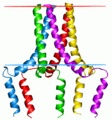 1zll opm


Medical Disclaimer: WikiMD is for informational purposes only and is not a substitute for professional medical advice. Content may be inaccurate or outdated and should not be used for diagnosis or treatment. Always consult your healthcare provider for medical decisions. Verify information with trusted sources such as CDC.gov and NIH.gov. By using this site, you agree that WikiMD is not liable for any outcomes related to its content. See full disclaimer.
Credits:Most images are courtesy of Wikimedia commons, and templates, categories Wikipedia, licensed under CC BY SA or similar.
Translate page: - East Asian
中文,
日本,
한국어,
South Asian
हिन्दी,
தமிழ்,
తెలుగు,
Urdu,
ಕನ್ನಡ,
Southeast Asian
Indonesian,
Vietnamese,
Thai,
မြန်မာဘာသာ,
বাংলা
European
español,
Deutsch,
français,
Greek,
português do Brasil,
polski,
română,
русский,
Nederlands,
norsk,
svenska,
suomi,
Italian
Middle Eastern & African
عربى,
Turkish,
Persian,
Hebrew,
Afrikaans,
isiZulu,
Kiswahili,
Other
Bulgarian,
Hungarian,
Czech,
Swedish,
മലയാളം,
मराठी,
ਪੰਜਾਬੀ,
ગુજરાતી,
Portuguese,
Ukrainian

