Nephrostomy
Nephrostomy is a procedure that involves the placement of a small, flexible rubber tube (or catheter) through the skin into the kidney to drain urine. It is typically performed when a blockage prevents the normal flow of urine from the kidneys to the bladder. The procedure is usually done under local anesthesia and guided by imaging techniques such as ultrasound or computed tomography (CT).
Indications[edit]
Nephrostomy is often indicated in cases where there is obstruction to the outflow of urine from the kidneys. This can occur due to a variety of conditions, including:
- Kidney stones
- Tumors in the urinary tract
- Strictures or narrowing of the urinary tract
- Infection in the urinary tract
- Congenital anomalies of the urinary tract
Procedure[edit]
The procedure is typically performed under local anesthesia and guided by imaging techniques such as ultrasound or computed tomography (CT). The patient is positioned on their stomach, and the skin over the kidney is cleaned and numbed. A needle is then inserted through the skin and into the kidney, and a wire is passed through the needle into the kidney. The needle is removed, and a catheter is threaded over the wire and into the kidney. The wire is then removed, leaving the cathet
Complications[edit]
While nephrostomy is generally safe, it can sometimes lead to complications, including:
- Infection
- Bleeding
- Injury to the kidney or surrounding structures
- Dislodgement or blockage of the catheter
Aftercare[edit]
After the procedure, patients are typically monitored for a short period of time to ensure that the catheter is functioning properly and that there are no immediate complications. Patients are also given instructions on how to care for the catheter at home, including how to clean the area around the catheter and how to empty the urine collection bag.
See also[edit]

This WikiMD article can only be edited by registered and verified editors. You can log in or register.
-
 Nephrostomy
 -
 Ultrasonography of percutaneous nephrostomy tube
 -
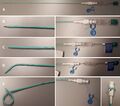 Pigtail catheter settings


Medical Disclaimer: WikiMD is for informational purposes only and is not a substitute for professional medical advice. Content may be inaccurate or outdated and should not be used for diagnosis or treatment. Always consult your healthcare provider for medical decisions. Verify information with trusted sources such as CDC.gov and NIH.gov. By using this site, you agree that WikiMD is not liable for any outcomes related to its content. See full disclaimer.
Credits:Most images are courtesy of Wikimedia commons, and templates, categories Wikipedia, licensed under CC BY SA or similar.
Translate page: - East Asian
中文,
日本,
한국어,
South Asian
हिन्दी,
தமிழ்,
తెలుగు,
Urdu,
ಕನ್ನಡ,
Southeast Asian
Indonesian,
Vietnamese,
Thai,
မြန်မာဘာသာ,
বাংলা
European
español,
Deutsch,
français,
Greek,
português do Brasil,
polski,
română,
русский,
Nederlands,
norsk,
svenska,
suomi,
Italian
Middle Eastern & African
عربى,
Turkish,
Persian,
Hebrew,
Afrikaans,
isiZulu,
Kiswahili,
Other
Bulgarian,
Hungarian,
Czech,
Swedish,
മലയാളം,
मराठी,
ਪੰਜਾਬੀ,
ગુજરાતી,
Portuguese,
Ukrainian

