Pan bagnat
Pan bagnat is a sandwich that is a specialty of the region of Nice, France. The name of the sandwich is derived from the local Provençal language, Nissart, in which "pan bagnat" means "bathed bread". It is a popular dish in the region, and is also commonly found in various forms in other parts of the French Riviera, and increasingly elsewhere in France.
Etymology[edit]
The term "pan bagnat" is derived from the Nissart dialect of the Provençal language, which is spoken in and around Nice. In Nissart, "pan" means bread and "bagnat" means bathed or wetted. This refers to the method of preparation of the sandwich, in which the bread is moistened with olive oil and other juices.
Ingredients and preparation[edit]
The pan bagnat is made with a round bread roll, typically of the type known as "pain de campagne", which is similar to a ciabatta. The bread is split and the inside is brushed with olive oil. The other ingredients are then layered inside the bread. These typically include raw vegetables such as lettuce, tomatoes, green peppers and spring onions, along with boiled eggs, tuna or anchovies, and sometimes also radishes and/or fava beans. The sandwich is then left to rest for a while before being served, so that the bread absorbs the juices from the ingredients.
Variations[edit]
There are many variations of the pan bagnat, both within its home region of Nice and elsewhere. Some versions include different types of fish or seafood, such as salmon or shrimp, while others include different types of vegetables or even different types of bread. However, the basic concept of a sandwich with a variety of ingredients, served in a moistened bread roll, remains the same.
See also[edit]

This WikiMD article can only be edited by registered and verified editors. You can log in or register.
-
 Pan bagnat sandwich with tuna, vegetables, and olives
 -
 Freshly baked bread
 -
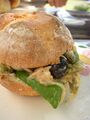 Pan bagnat with ingredients displayed


Medical Disclaimer: WikiMD is for informational purposes only and is not a substitute for professional medical advice. Content may be inaccurate or outdated and should not be used for diagnosis or treatment. Always consult your healthcare provider for medical decisions. Verify information with trusted sources such as CDC.gov and NIH.gov. By using this site, you agree that WikiMD is not liable for any outcomes related to its content. See full disclaimer.
Credits:Most images are courtesy of Wikimedia commons, and templates, categories Wikipedia, licensed under CC BY SA or similar.
Translate page: - East Asian
中文,
日本,
한국어,
South Asian
हिन्दी,
தமிழ்,
తెలుగు,
Urdu,
ಕನ್ನಡ,
Southeast Asian
Indonesian,
Vietnamese,
Thai,
မြန်မာဘာသာ,
বাংলা
European
español,
Deutsch,
français,
Greek,
português do Brasil,
polski,
română,
русский,
Nederlands,
norsk,
svenska,
suomi,
Italian
Middle Eastern & African
عربى,
Turkish,
Persian,
Hebrew,
Afrikaans,
isiZulu,
Kiswahili,
Other
Bulgarian,
Hungarian,
Czech,
Swedish,
മലയാളം,
मराठी,
ਪੰਜਾਬੀ,
ગુજરાતી,
Portuguese,
Ukrainian

