Pan American Health Organization
Pan American Health Organization (PAHO) is an international public health agency with a wide range of responsibilities and goals aimed at improving health and living standards across the Americas. It serves as the Regional Office for the Americas of the World Health Organization (WHO) and is part of the United Nations system. PAHO was established in December 1902 and is the world's oldest international public health agency.
History[edit]
The foundation of PAHO predates the establishment of the WHO by nearly half a century. It was initially created to combat the spread of diseases like yellow fever and malaria across countries in the Americas. Over the years, PAHO has played a crucial role in eradicating smallpox, controlling polio, and tackling other public health challenges in the region.
Mission and Objectives[edit]
PAHO's mission is to lead strategic collaborative efforts among Member States and other partners to promote equity in health, combat disease, and improve the quality of life of the peoples of the Americas. Its objectives include strengthening national and local health systems, promoting universal health coverage, and responding to public health emergencies.
Structure[edit]
PAHO operates through its headquarters in Washington, D.C., country offices located in its member states, and a network of specialized centers. The organization is governed by the Directing Council, which is composed of health authorities from its 35 member countries. The Council meets annually to set health priorities and policies for the region.
Programs and Initiatives[edit]
PAHO's work encompasses a broad range of programs and initiatives aimed at addressing key health issues in the Americas, including communicable diseases, non-communicable diseases, family health, life course, and health emergencies. It also focuses on strengthening health systems and services, based on primary health care strategies.
Achievements[edit]
PAHO has been instrumental in several public health milestones in the Americas, such as the eradication of smallpox in 1971, the elimination of polio in 1994, and ongoing efforts to combat HIV/AIDS, tuberculosis, and malaria. The organization also plays a critical role in disaster response and preparedness, providing technical assistance and mobilizing resources to affected areas.
Challenges[edit]
Despite its achievements, PAHO faces ongoing challenges, including emerging and re-emerging infectious diseases, the impact of climate change on health, and the need to address non-communicable diseases, such as heart disease, cancer, and diabetes, which are the leading causes of death in the region.
Collaboration[edit]
PAHO collaborates with a wide range of partners, including member governments, other United Nations agencies, civil society organizations, academic institutions, and the private sector, to achieve its health objectives in the Americas.
Funding[edit]
The organization's work is funded through a combination of member state contributions, voluntary contributions from member states and other partners, and other sources.
See Also[edit]
 | This medical article is a stub. You can help WikiMD by expanding the page. |
-
 Pan American Health Organization Logo
 -
 Pan American Health Organization Building
 -
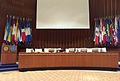 PAHO Auditorium Stage in Washington, D.C.


Medical Disclaimer: WikiMD is for informational purposes only and is not a substitute for professional medical advice. Content may be inaccurate or outdated and should not be used for diagnosis or treatment. Always consult your healthcare provider for medical decisions. Verify information with trusted sources such as CDC.gov and NIH.gov. By using this site, you agree that WikiMD is not liable for any outcomes related to its content. See full disclaimer.
Credits:Most images are courtesy of Wikimedia commons, and templates, categories Wikipedia, licensed under CC BY SA or similar.
Translate page: - East Asian
中文,
日本,
한국어,
South Asian
हिन्दी,
தமிழ்,
తెలుగు,
Urdu,
ಕನ್ನಡ,
Southeast Asian
Indonesian,
Vietnamese,
Thai,
မြန်မာဘာသာ,
বাংলা
European
español,
Deutsch,
français,
Greek,
português do Brasil,
polski,
română,
русский,
Nederlands,
norsk,
svenska,
suomi,
Italian
Middle Eastern & African
عربى,
Turkish,
Persian,
Hebrew,
Afrikaans,
isiZulu,
Kiswahili,
Other
Bulgarian,
Hungarian,
Czech,
Swedish,
മലയാളം,
मराठी,
ਪੰਜਾਬੀ,
ગુજરાતી,
Portuguese,
Ukrainian

